
Lesson 17 of 25 · 10 min
Anchoring, docking, lines and knots
Pick the right anchor, set it so it holds, dock in wind and current, and tie four key knots.
17.1
Pick the anchor for the bottom
No anchor holds everywhere. Match it to the bottom you fish over, and size it for your boat.
- Fluke (Danforth-style): two flat, pointed flukes dig into sand and firm mud. It holds very well for its weight, so many small boats carry one.
- Plow: a pointed, plow-shaped head.
- Mushroom: a heavy, bowl-shaped weight.
- Grapnel: several curved prongs.
Which type is best depends on your boat, how you anchor and the bottom. Ask your dealer for a size chart for your boat.
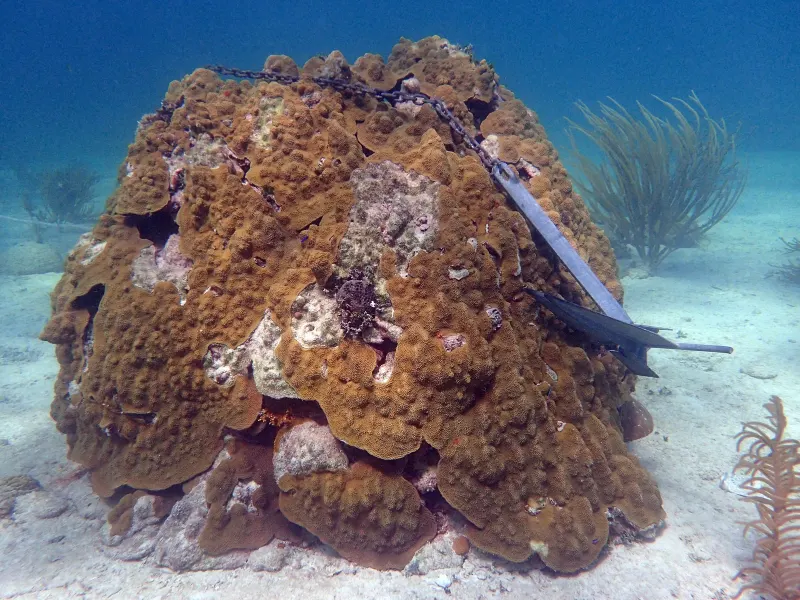
How bottoms hold: firm sand and clay hold best. Mud varies. Rock and coral hold only if the anchor catches in a crack. Grass keeps most anchors from digging in.
Sand and clay hold best. Grass and rock hold worst.
17.2
Scope: let out enough line
Scope is how much anchor line (the rode) you let out, compared with the depth. Measure the water depth plus the height of your bow above the water.
- The usual rule: 5 to 7 times that total.
- Staying overnight, or the wind is building? Use the high end, 7 to 1.
- In heavy weather, the Coast Guard's crew handbook goes to 10 to 1.
Why: a long, low pull drags the flukes into the bottom. A short, steep line tends to lift the anchor out.
Example: 8 feet of water plus 2 feet of bow is 10 feet. Let out 50 to 70 feet of line.
A few feet of chain between the anchor and the rope helps too. It keeps the pull low and protects the rope from rock and coral.
(Depth + bow height) × 5 to 7.
17.3
Set it from the bow
- Check the chart. Pick a spot with room to swing a full circle, clear of other boats and cables.
- Come in slowly, heading into the wind or current, and stop.
- Lower the anchor from the bow, hand over hand. Don't throw it: it can tangle in its own line.
- Back away slowly as line pays out. Keep a turn around the bow cleat so the line can't run away from you.
- At full scope, hold the line. The anchor should bite and the boat should stop.
- Make the line fast to the bow cleat.
Never anchor from the stern. Waves can pour over the low transom and swamp you. Skill 7 shows why.
Agree on hand signals between the helm and the bow first. Engine and wind noise drown out voices.
Bow only. Lower it, don't throw it.
17.4
Stay on watch, then pull it up
Once you're set, pick two landmarks on shore, well apart. If they shift but your boat's heading doesn't, you're dragging. A plotter anchor alarm helps, but keep looking too.
Also watch for a jerking or shaking line, weather changes, and other boats dragging toward you.
Pulling it up:
- Idle forward slowly while the bow person takes in line. Keep the line away from the propeller.
- When the line points straight down, the anchor usually breaks free.
- Stuck? Cleat the line and ease ahead a few feet. Still stuck? Circle slowly to pull from another angle.
- Rinse off the mud, then stow the anchor so it can't slide around.
Two landmarks. If they move, you're dragging.
17.5
Anchored at night or in fog
From sunset to sunrise, an anchored boat under 50 meters (164 feet) shows one all-round white light. Put it where it can best be seen.
- Turn off your red and green sidelights. At anchor, they tell other boats you're underway.
- Under 7 meters (23 feet)? You may skip the anchor light, but only away from channels, fairways, anchorages and places boats normally travel.
- Fishing at night near a channel? Show the light, whatever your size.
- In fog, an anchored boat under 12 meters (39 feet) sounds an efficient signal at least every 2 minutes.
At anchor after dark: one white light, seen all around.
17.6
Florida: where you can't anchor
- Not in a busy channel or under a bridge. If it's unreasonable, Florida law calls that interfering with navigation. Officers can have your boat moved.
- Not within 150 feet of a marina, boat ramp, boatyard or launch facility. Not within 300 feet of a marked public mooring field.
- Those distance limits don't apply while you're actively fishing with hook and line. Engine failure and dangerous weather are exceptions too.
- Anchoring limitation areas: some Florida waters, marked with signs and buoys, limit overnight or long stays. Read the signs.
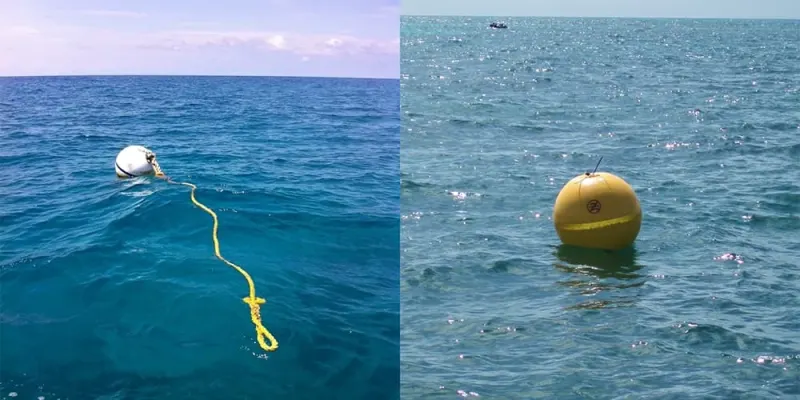
- Florida Keys sanctuary: never anchor on living coral in water under 40 feet when you can see the bottom. In its protected zones, use a mooring buoy when one is free.
Whenever you can, anchor in bare sand, not on seagrass or coral.
Not in the channel, not by the ramp, not on coral.
17.7
Docking with wind and current
Wind and current are the biggest forces at a dock. Use them; don't fight them.
- Come in against the wind or current when you can. It slows you down and gives you more control.
- Control, not speed. Use just enough power to steer, in short bursts, then back to neutral.
- Wind blowing you off the dock? Approach at a sharp angle, 45 degrees or more.
- Wind blowing you onto the dock? Come in parallel and stop moving forward. Let the wind ease you sideways onto your fenders.
Lines and fenders: a bow line and a stern line hold the boat in. Two spring lines stop it surging forward and back. Hang fenders where the hull meets the dock. Never fend off with hands or feet.
Get lines and fenders ready before you approach, and tell the crew the plan. Skill 10 has the basics.
Into the wind or current. Slow. Fenders ready.
17.8
Four knots every boater needs
Cleat hitch (tie off to a cleat):
- Take a full turn around the base of the cleat.
- Cross over the top and around the other horn, making a figure eight.
- Add two more figure eights.
- Finish with a locking hitch: twist a loop so the line lies under itself on one horn.
Bowline (a fixed loop that won't slip or jam):
- Make a small overhand loop in the line.
- Pass the end up through the loop.
- Take it around behind the standing part.
- Bring it back down through the loop. Pull tight.
Clove hitch (quick tie to a post or rail): wrap the end around the post so it crosses itself. Wrap again and tuck the end under that second wrap. Add a half hitch so it can't work loose.
Two half hitches (tie to a ring or piling): take a turn around it. Pass the end around the line and back under itself. Do it twice.
Coil loose line and stow it, so no one trips on it or gets a foot caught.
Cleat hitch for cleats. Bowline for a loop.
Try it
Tie the four knots. Watch each step, then put them in order.
Tie off to a cleat.
Brass tip: the end you work with
Step 1 of 4Take a full turn around the base of the cleat.
Practice with a real line. Coil loose line and stow it, so no one trips on it.
Try it
Let out enough line. See why short scope drags.
Total depth: 10 ft (8 ft of water + 2 ft of bow) × 5
Let out: 50 ft
Pull angle (bow to anchor): about 12°
Low pull digs it in.
Clear: they're 75 ft from your anchor, outside your 50 ft circle.
Scope
Usual rule 5 to 7. Overnight or wind building: 7. Heavy weather: up to 10.
Simplified: the drawing shows the idea, not your anchor. The boat isn't to scale.
Try it
Dock in wind and current. Pick your angle and speed.
A 12-knot wind is blowing straight off the dock, away from it.
Pick your approach, then Go
Simplified: real wind, current and boats vary. Get lines and fenders ready before you approach, and tell the crew the plan.
Your turn
8 decisions8 real situations. Decide first, then read why.
These come back for review later, because remembering on the water is what counts.
A day on the water
3 story tripsUse it on a whole day out.
Story trips from the morning forecast to the ride home. You make the calls; a bad one plays out so you see why the rule exists.
Sources
Checked 2026-11-05- 1FWC Boating Accident Statistical Report 2025Florida boating accidents, causes and deaths2025 report, retrieved 2026-11-05
- 2USCG Recreational Boating Statistics 2024U.S. boating deaths, causes and life jacket use2024 report (latest national; 2025 due Oct 31, 2026)
- 3NASBLA ESP TR 103 (technical report)Guidance for teaching the national boating standard: trailering, docking, anchoring, boarding, stormsVersion 1.0, June 2022 (guidance, not a rule)
- 4USCG Auxiliary: Anchoring (newspaper article 4)Common anchor types (plow, grapnel, mushroom, Danforth); choose by boat and bottom; 7:1 scope, lower don't throw, back down to set, watch landmarks to check for draggingUndated public-education article (PDF created Nov 2014), checked Nov 5, 2026
- 5USCG Boat Crew Handbook: Seamanship Fundamentals (BCH 16114.4)Knots (bowline, clove hitch, two half hitches) and securing a line to a cleat; docking in wind and current, mooring lines and fenders; anchor parts, bottom types, scope 5:1 to 7:1 measured against water depth only (10:1 heavy weather), setting, checking, weighing and freeing an anchor; never anchor by the sternDec 13, 2017 (Coast Guard crew handbook; recreational use is our adaptation; checked Nov 5, 2026)
- 6USCG: A Boater's Guide to the Federal RequirementsLoading, anchoring, fueling, float plans and checklistsRevised Nov 2023
- 733 CFR 83.30 (Rule 30)Lights for anchored boatseCFR, current through Oct 22, 2026
- 833 CFR 83.20 (Rule 20)Show navigation lights from sunset to sunrise, and in daytime when visibility is restricted; show no other lights that can be mistaken for the required oneseCFR, current through Nov 3, 2026 (checked Nov 5, 2026)
- 933 CFR 83.35 (Rule 35)Horn signals in fogeCFR, current through Oct 22, 2026
- 1033 CFR 83.03 (Rule 3)Definitions, including "engaged in fishing" (trolling doesn't count)eCFR, current through Oct 22, 2026
- 11Fla. Stat. 327.44(2)No anchoring that unreasonably blocks navigation; anchoring under bridges or in or next to heavily traveled channels can be interference2026 Florida Statutes (flsenate.gov, checked Nov 5, 2026)
- 12Fla. Stat. 327.4109No anchoring within 150 ft of a marina, boat ramp, boatyard or launch facility, 500 ft of a superyacht repair facility, or 300 ft of a marked public mooring field; exceptions for active hook-and-line fishing, mechanical failure and dangerous weather2026 Florida Statutes (flsenate.gov, checked Nov 5, 2026)
- 13Fla. Stat. 327.4108Anchoring limitation areas: listed areas with no anchoring from a half hour after sunset to a half hour before sunrise; county areas marked by signs and buoys with stay limits; recreational anglers actively fishing are excluded2026 Florida Statutes (amended by ch. 2026-36), read via web reader on flsenate.gov, checked Nov 5, 2026
- 1415 CFR 922.163Florida Keys National Marine Sanctuary: no prop-scarring or striking coral or seagrass; no prop-dredging; no anchoring on living coral in under 40 ft when the bottom is visible; MSDs must be secured; no releasing exotic specieseCFR, current through Nov 3, 2026 (checked Nov 5, 2026)
- 1515 CFR 922.164Florida Keys sanctuary protected zones: use a mooring buoy instead of anchoring when one is available; anchors must not touch coraleCFR, current through Nov 3, 2026 (checked Nov 5, 2026)
- 16Florida Sea Grant SGEB 73: Boating and Angling Guide to Biscayne BayAnchor only in bare sandy bottoms; use mooring buoys instead of anchoring on reefs; seagrass damage in aquatic preserves is a violationUniversity of Florida / Florida Sea Grant map guide, revised for accessibility Apr 23, 2026 (checked Nov 5, 2026)
- 17FWC: Seagrass FAQProp scars take months or years to recoverUndated web page
Checked against these sources on November 5, 2026.
Free practice lessons, not an FWC-approved course: they don't issue the Florida Boating Safety Education ID Card. Covers national standard topics P5.6.3, P5.6.2, C5.2, C3.2, C9.2 and Florida rule 68D-36.104 (2)(j).