
Introduction to Vessels and Hull Types
Introduction
Every journey into boating begins with understanding what makes a vessel float, how it moves through water, and why certain designs excel in specific conditions while failing in others. The difference between a hull that displaces water and one that planes across its surface isn't just technical trivia-it determines whether a boat can safely handle the conditions you'll encounter, how much fuel you'll consume, and even whether certain navigation rules apply to you.
Understanding hull design connects directly to safety. A flat-bottom Jon boat perfect for calm lake fishing becomes dangerously unstable in three-foot ocean swells. A deep-V offshore hull built for rough seas wastes fuel and rides uncomfortably in the protected bay where you actually boat. Knowing these fundamental differences helps you choose appropriate vessels, recognize dangerous mismatches between boat and conditions, and operate within your vessel's design limits.
This lesson covers the legal definition of vessels, the physics governing how boats float and move, hull types (displacement, planing, semi-displacement, and multihulls), common hull shapes, and how design affects handling, speed, and stability. This foundational knowledge applies to every subsequent topic in this course.
What Defines a Vessel
Legal Definition
Under federal law (1 U.S.C. § 3), a vessel is "every description of watercraft or other artificial contrivance used, or capable of being used, as a means of transportation on water."
This broad definition includes:
- Powerboats of all sizes
- Sailboats
- Personal watercraft (PWC)
- Kayaks and canoes
- Inflatable boats
- Houseboats
- Jet skis
- Even paddleboards with motors
Not included:
- Swimming pool toys
- Non-motorized floatation devices not designed for transportation
- Surfboards (without motors)
- Stationary platforms not capable of movement
Why this matters: If it's a vessel, federal regulations apply. Equipment requirements, navigation rules, and operator responsibilities attach to "vessels," not just "boats." A kayak with a small electric trolling motor becomes a vessel subject to registration, equipment requirements, and navigation rules.
Watercraft vs. Vessel
"Watercraft" is a broader term encompassing anything that floats and can carry people or cargo. "Vessel" is a legal classification triggering specific requirements. A bathtub toy is watercraft but not a vessel. A canoe is both watercraft and a vessel.
This distinction matters for:
- Registration requirements: Vessels with propulsion must be registered (33 CFR 174)
- Equipment requirements: Only vessels must carry safety equipment (33 CFR 175)
- Navigation rules: Only vessels must follow right-of-way rules (33 CFR 83)
- Operator education: States mandate education for vessel operators, not all watercraft users
Hull Physics: Buoyancy vs. Lift
Understanding how boats stay afloat and move requires grasping two fundamental forces: buoyancy and lift.
Buoyancy: Archimedes' Principle
Archimedes' Principle states: Any object immersed in fluid experiences an upward force equal to the weight of the fluid it displaces.
In practice: A boat floating at rest displaces water equal to its total weight. If the boat weighs 3,000 pounds, it displaces exactly 3,000 pounds of water. Since freshwater weighs approximately 62.4 pounds per cubic foot and saltwater weighs about 64 pounds per cubic foot, you can calculate the volume of hull below the waterline.
Example calculation:
- 3,000-pound boat in freshwater
- Water weight: 62.4 lbs/cubic foot
- Volume displaced: 3,000 ÷ 62.4 = 48 cubic feet below waterline
Buoyancy governs:
- All vessels at rest
- Displacement hulls at all speeds
- Planing hulls below planing speed
- How much additional weight a boat can safely carry
Hydrodynamic Lift: Planing Force
Hydrodynamic lift is an upward force created by water pressure differences as the hull moves through water at speed. Similar to how airplane wings generate lift, planing hulls redirect water downward, creating an upward reaction force.
How it works:
- Hull moves forward through water
- Hull bottom deflects water downward
- Newton's Third Law: downward water force creates equal upward force on hull
- At sufficient speed, lift force exceeds vessel weight
- Hull rises partially out of water, reducing wetted surface
- Less drag = higher speed with same power
Planing enables:
- Speeds far exceeding hull speed limitations
- Reduced fuel consumption at planing speeds (compared to transition zone)
- Ability to "get on top" of rough water
- Water sports requiring higher speeds
The critical transition: Moving from displacement mode (buoyancy only) to planing mode (buoyancy + lift) requires significant power. This transition zone (called "hump speed" or "bow-up attitude") is the most inefficient operating regime, consuming maximum fuel for moderate speed as the bow rises while the stern digs in.
Displacement Hulls
Characteristics
Displacement hulls push through water rather than riding over it, remaining supported primarily by buoyancy at all speeds. The hull stays submerged to approximately the same level regardless of speed.

Key identifying features:
- Round or V-shaped bottoms curving smoothly to the keel
- Deeper draft (more hull below waterline)
- Heavier construction typical
- Lower center of gravity
- Full-length keel structures
Hull Speed Limitation
Displacement hulls face a mathematical speed barrier called hull speed, calculated by:
Hull Speed (knots) = 1.34 × √(Waterline Length in Feet)
Example:
- 25-foot waterline length
- Hull speed = 1.34 × √25 = 1.34 × 5 = 6.7 knots maximum
Why this limit exists: As a displacement hull moves, it creates a bow wave and stern wave. The faster it goes, the farther apart these waves spread. At hull speed, the bow wave is at the bow and the stern wave is at the stern-the boat sits in a trough between its own waves. Adding more power only digs the stern deeper into the stern wave; the boat cannot climb over it without fundamentally changing to planing mode.
Attempting to exceed hull speed:
- Creates massive stern wave (wasting energy)
- Bow rises excessively (dangerous visibility reduction)
- Fuel consumption skyrockets
- Boat becomes difficult to control
- Structural stress increases
Practical implication: A 36-foot displacement trawler has hull speed of 8 knots (1.34 × √36 = 8.04 knots). Installing a 500-horsepower engine won't make it go 20 knots-it's limited by physics, not power.
Advantages of Displacement Hulls
Fuel Efficiency: Operating near hull speed provides maximum efficiency. The hull moves smoothly through water with minimal resistance. Typical displacement hulls achieve 2-4 nautical miles per gallon at cruising speed-far exceeding planing hull efficiency.
Comfortable Ride: The deep hull cuts through waves rather than pounding over them. Motion is generally smoother in moderate sea conditions. The deeper draft and lower center of gravity reduce rolling.
Load Carrying: Full-depth hulls offer maximum interior volume and cargo capacity. Heavy-duty construction supports significant weight without performance degradation.
Range: Combining efficiency with large fuel capacity, displacement hulls can travel vast distances. Ocean-crossing trawlers and long-range cruisers use displacement designs for reliability and endurance.
Quieter Operation: Lower speeds and efficient propeller operation reduce noise levels, making displacement hulls popular for living aboard and extended cruising.
Disadvantages of Displacement Hulls
Speed Limitations: Cannot participate in water sports requiring high speeds. Long travel times between destinations. Cannot outrun approaching weather.
Less Exciting: Some boaters find displacement speeds boring, preferring the thrill of planing performance.
Size/Weight: Generally heavier and more expensive to build, transport, and maintain than comparable planing hulls.
Maneuverability: Larger displacement vessels turn slowly and require significant space to stop.
Typical Applications
- Trawlers: Long-range cruising and living aboard (30-65 feet typical)
- Sailboats under power: When not sailing, sailboat hulls operate in displacement mode
- Large yachts: Mega-yachts over 80 feet often use displacement designs
- Commercial vessels: Tugs, workboats, and commercial fishing vessels
- Canal boats: Purpose-built for inland waterway cruising
Planing Hulls
Characteristics
Planing hulls are designed to rise up and skim across the water surface at speed, dramatically reducing wetted surface and enabling high speeds.

Key identifying features:
- Flatter bottom sections with sharp chines (angle where bottom meets side)
- Shallower draft
- Lighter construction materials
- Trim tabs or adjustable drives for attitude control
- Powerful engines relative to weight
Three Operating Modes
Planing hulls operate in three distinct modes:
1. Displacement Mode (Below ~7-10 mph)
- Hull operates exactly like displacement hull
- Fully supported by buoyancy
- Subject to hull speed limitations
- High fuel consumption relative to speed
- Inefficient for cruising at these speeds
2. Transition Mode (7-18 mph typical)
- Bow rises dramatically ("bow-up" attitude)
- Stern digs deeper into water
- Massive stern wave created
- Highest fuel consumption per mile traveled
- Dangerous visibility reduction from bow-up attitude
- Least stable operating condition
- Goal: pass through quickly to reach plane
3. Planing Mode (Above ~18-25 mph)
- Hull lifts partially out of water
- Level or slightly bow-up running attitude
- Reduced wetted surface
- Maximum speed achieved
- Good fuel efficiency at cruising plane
- Stable and predictable handling
Getting "on plane": Requires significant power burst to overcome transition zone resistance. Once on plane, throttle can reduce while maintaining planing speed. The transition is felt as the bow dropping down and boat surging forward as drag suddenly decreases.
Advantages of Planing Hulls
High Speed Capability: Easily exceeds hull speed limitations. Enables water sports (skiing, wakeboarding, tubing). Reaches distant destinations quickly.
Versatility: Can operate efficiently at displacement speeds for no-wake zones, then accelerate to planing speeds for open water. Adaptable to varying conditions.
Exciting Performance: Acceleration, speed, and handling provide thrilling boating experiences many users prefer.
"Getting Out": Can outrun approaching thunderstorms, get off rough water quickly, or escape hazardous situations that would trap slower displacement hulls.
Fuel Efficiency at Plane: While transition is inefficient, cruising on plane at moderate speeds (20-30 mph) can achieve reasonable fuel economy-often 3-5 mpg for lighter boats.
Disadvantages of Planing Hulls
Rough Water Pounding: Flat bottoms slam into waves, creating harsh impacts. Uncomfortable or dangerous in significant seas. Must slow to displacement speeds in rough conditions, negating speed advantage.
Fuel Consumption: Powerful engines and high speeds consume fuel quickly. Short range compared to displacement hulls. Transition zone is extremely inefficient.
Complexity: More systems to maintain (trim tabs, high-performance engines, cavitation plates). Higher repair costs.
Draft Variability: Changes with speed and load. Hull may draft 3 feet at rest but only 1 foot on plane, affecting navigation and grounding risk when stopping.
Typical Applications
- Runabouts: Family day boats 16-30 feet
- Bowriders: Popular recreational boats with seating at bow
- Center consoles: Fishing boats 18-40 feet
- Bass boats: High-performance fishing boats
- Ski/wake boats: Specifically designed for water sports
- Go-fast boats: Performance boats exceeding 60+ mph
Semi-Displacement Hulls
Characteristics
Semi-displacement hulls blend displacement and planing characteristics, offering efficiency near hull speed but capability to exceed it with sufficient power.
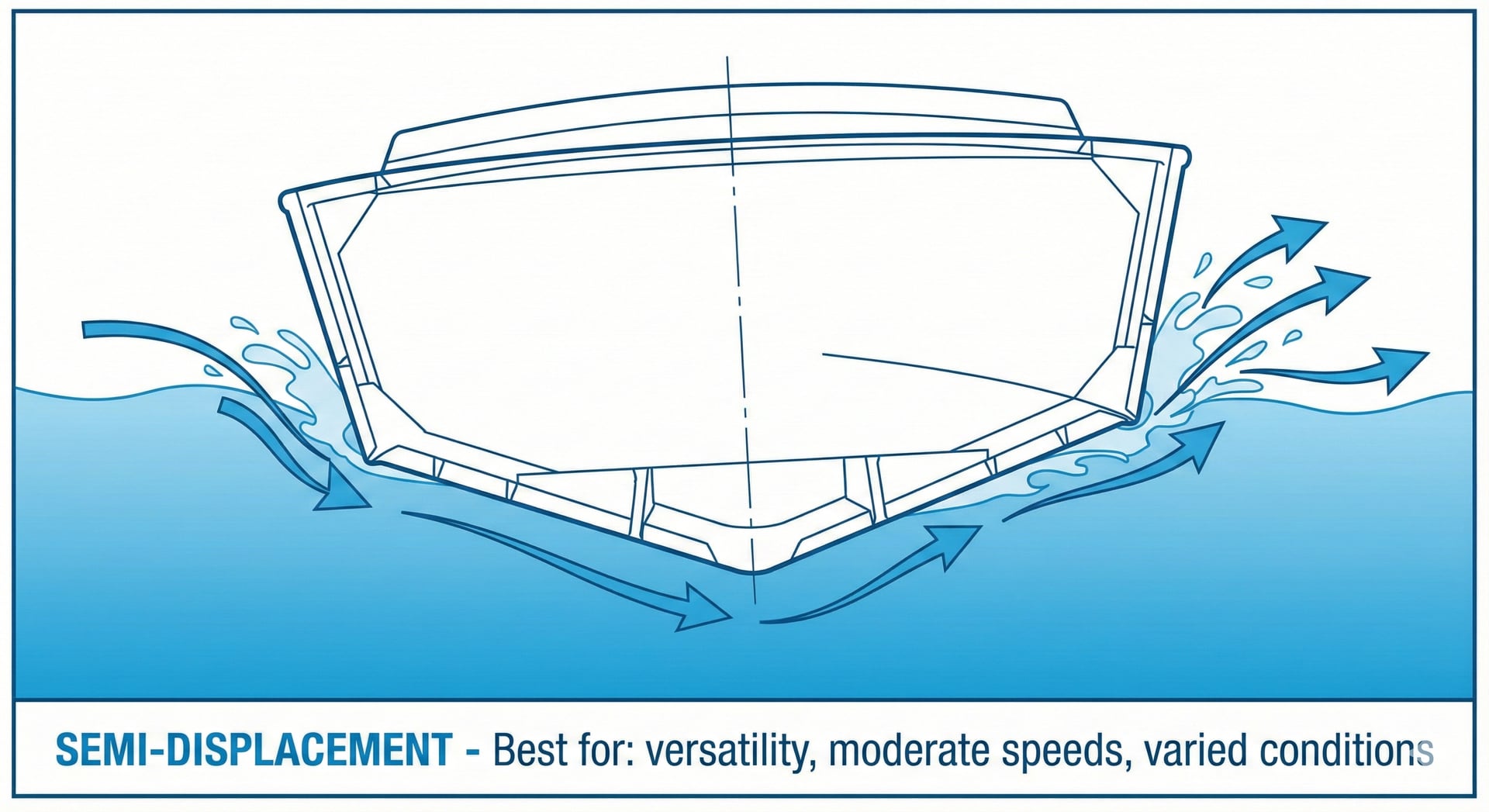
Key identifying features:
- Modified V-bottoms with some deadrise (V-angle)
- Moderate chines (between round displacement and hard planing)
- Medium draft
- Capable of moderate planing
- Often called "fast displacement" or "semi-planing"
Operating Envelope
Optimal speed range: 1.2 to 2.0 × hull speed
- Below hull speed: operates as displacement hull
- 1.2-1.5 × hull speed: semi-planing with partial lift
- Above 2.0 × hull speed: requires excessive power, inefficient
Example: 36-foot semi-displacement hull
- Hull speed: 8 knots
- Optimal semi-displacement range: 9.6 to 16 knots
- Can achieve 18-20 knots but inefficiently
Advantages
Efficiency: More efficient than planing hulls across wider speed range. Better than displacement hulls when moderate speed increase needed.
Versatility: Comfortable at displacement speeds, capable of higher speeds when needed.
Sea-Keeping: Better rough-water performance than planing hulls. More forgiving than pure displacement in following seas.
Compromise: For cruisers who want efficiency but occasional speed, semi-displacement offers balance.
Disadvantages
Compromise Design: Doesn't excel at either extreme. Not as efficient as pure displacement at low speed, not as fast as planing hulls.
Complex Design: More expensive to design and build properly than pure displacement or planing.
Power Requirements: Needs more power than displacement but won't reach planing hull speeds.
Typical Applications
- Motor yachts: Cruising yachts 40-80 feet
- Trawler-yachts: Blend trawler comfort with moderate speed
- Express cruisers: Faster cabin cruisers
- Sportfishing boats: Offshore fishing boats needing efficient cruise but capability for speed
Multihull Designs
Catamarans (Two Hulls)
Configuration: Two parallel hulls connected by a bridge deck or platform.

Advantages:
- Exceptional stability: Wide beam resists heeling (tipping). Stable platform for fishing, diving, or cruising.
- Shallow draft: Twin narrow hulls draft less than equivalent monohull. Access to thin waters.
- Interior space: Bridge deck provides vast interior volume. Separate hulls allow privacy (staterooms in each hull).
- Reduced rolling: Wider stance reduces side-to-side motion.
- Speed potential: Powercat designs can achieve high speeds efficiently.
Disadvantages:
- Beam restrictions: 16-20+ foot beams require special docking and storage. Trailering often impossible.
- Maneuvering: Wide beam and separated propellers can make close-quarters maneuvering challenging.
- Structural stress: Bridge connecting hulls experiences stress from wave action. Requires strong construction.
- Cannot self-right: If capsized, catamarans remain inverted. Monohulls typically roll back upright.
- Cost: Complex construction increases purchase price and maintenance.
Applications:
- Cruising sailboats (40-60+ feet)
- Power catamarans (25-50+ feet)
- Sport fishing cats (30-40+ feet)
- Dive boats and tour boats (stable platform)
Trimarans (Three Hulls)
Configuration: Central main hull with two smaller outrigger hulls (amas) on either side.
Advantages:
- Speed: Narrower main hull achieves higher speeds than catamarans.
- Stability: Outriggers provide stability without extreme beam.
- Better sea-keeping: Main hull cuts waves; outriggers provide stability.
- Efficiency: Less drag than catamarans in many conditions.
Disadvantages:
- Complexity: Three hulls complicate construction and systems.
- Beam: Still wider than monohulls (though less than cats).
- Limited applications: Mainly sailing designs; power tris are rare.
Applications:
- Performance cruising sailboats
- Racing sailboats
- Limited power applications
Common Hull Shapes
Beyond displacement/planing classification, hull bottom shapes affect performance:
Flat Bottom (0-5 degrees deadrise)
Characteristics: Minimal V-angle; bottom nearly flat across beam.
Advantages:
- Maximum initial stability (feels solid at rest)
- Excellent for calm, protected waters
- Shallow draft
- Easy to build, low cost
- Good load capacity
Disadvantages:
- Brutal pounding in waves
- Dangerous in rough water
- Limited speed capability
- Slapping, splashing through chop
Applications: Jon boats, utility boats, some pontoons, shallow-water skiffs
V-Bottom (10-24+ degrees deadrise)
Deadrise is the V-angle measured at the transom (stern). Higher deadrise = sharper V = better rough-water performance.
Modified V (10-18 degrees):
- Balance between stability and ride quality
- Acceptable in moderate chop
- Good all-around performers
- Family runabouts, multi-purpose boats
Deep-V (19-24 degrees):
- Soft ride in rough water
- Cuts through waves
- Less stable at rest (rocks more)
- Offshore fishing boats, performance boats
Extreme Deep-V (24+ degrees):
- Maximum rough-water capability
- Very soft ride even in severe seas
- Noticeable roll at rest
- Requires significant power
- Offshore center consoles, sportfish yachts
Variable deadrise: Many hulls use variable deadrise-sharper V at bow (cut waves), flatter at stern (planing efficiency). This combines advantages of both configurations.
Cathedral Hull (Tri-Hull)
Configuration: Three distinct planing surfaces-center V with flat outer panels.
Advantages:
- Stable platform (wide stance)
- Reasonable rough-water capability
- Good planing performance
- Family-friendly
Disadvantages:
- Can pound in head seas
- Spray issues
- Less efficient than pure designs
Applications: Ski boats, family runabouts, some fishing boats (popular 1970s-1980s, less common now)
Pontoon Hull
Configuration: Two or three cylindrical aluminum tubes supporting a deck.

Advantages:
- Maximum deck space for length
- Exceptional stability
- Comfortable platform for families
- Easy boarding/swimming access
- Moderate cost
Disadvantages:
- Poor rough-water performance (should avoid waves over 2 feet)
- Wind-affected (large flat surfaces)
- Limited speed (traditional designs ~25 mph maximum)
- Difficult to beach or ground
- Performance pontoons (tritoons with 300+ HP) partially address speed limitations
Applications: Inland lakes, calm rivers, protected bays, family recreation, fishing platforms
How Hull Design Affects Handling, Speed, and Stability
Handling Characteristics
Flat-bottom hulls:
- Quick turning (low lateral resistance)
- Skittish in crosswinds
- Oversteer tendencies
- Good for tight rivers and shallow waters
Deep-V hulls:
- Stable tracking (keel-like effect)
- Resist side-slipping in turns
- More predictable in following seas
- Better crosswind performance
Catamarans:
- Different turning characteristics (twin engines far apart)
- Can pivot in place
- Wide turning radius under single engine
- Stable in beam seas
Speed Potential
Displacement: Limited by hull speed formula (1.34 × √waterline length)
Planing: Limited by power, weight, and hull efficiency
- Light hulls + high power = high speed
- Heavy hulls require more power to plane
- Aerodynamics matter above 40 mph
Semi-displacement: Moderate speeds (1.2-2.0 × hull speed)
Stability Considerations
Initial stability (resistance to heeling when you step aboard):
- High: Flat bottom, wide beam, pontoons
- Medium: Modified V, cathedral
- Low: Deep-V, narrow hulls
Ultimate stability (angle boat can heel before capsizing):
- High: Deep-V, sailboat keels
- Medium: Modified V
- Low: Flat bottom (sudden capsizing once tipped)
Critical safety point: High initial stability feels safer but can lead to dangerous overconfidence. Flat-bottom boats feel rock-solid in calm water but capsize suddenly in rough conditions. Deep-V boats feel "tippy" initially but can heel to extreme angles safely.
Choosing the Right Hull for Conditions
Calm Protected Waters (Lakes, Rivers, Bays)
- Flat-bottom: Jon boats, utility boats
- Pontoons: Family cruising
- Modified V: Versatile choice
Moderate Chop (Large Lakes, Near-Coastal)
- Modified V (15-18 degrees deadrise)
- Cathedral hulls
- Light deep-V
Rough Offshore Waters
- Deep-V (20+ degrees deadrise)
- Semi-displacement (larger sizes)
- Catamarans (larger, well-built)
Multi-Environment (Varies by Season/Location)
- Modified V (best compromise)
- Semi-displacement (if size appropriate)
Speed-Focused Activities
- Planing hulls (bass boats, ski boats, performance boats)
- Variable deadrise for versatility
Efficiency-Focused Cruising
- Displacement (trawlers)
- Semi-displacement (motor yachts)
- Sailboats
Summary
Understanding hull types and design fundamentals provides the foundation for everything else in boating. The hull determines how your boat performs, what conditions it can safely handle, what speeds it can achieve, and how efficiently it operates. Recognizing the difference between displacement and planing operation, understanding deadrise angles and their effects, and matching hull design to intended use prevents dangerous mismatches between boat capabilities and operating conditions.
Every regulation, navigation rule, and safety procedure you'll learn in subsequent modules applies differently depending on vessel type. Knowing whether you're operating a displacement, planing, or semi-displacement hull helps you anticipate how your boat will respond, what limitations it faces, and what special considerations apply.
The physics governing hull performance-buoyancy, hydrodynamic lift, hull speed limitations, stability characteristics-aren't academic abstractions. They're practical realities that determine whether you'll have a safe, enjoyable boating experience or encounter dangerous situations beyond your vessel's capabilities. Respecting these physical principles and choosing appropriate hull designs for your intended use is fundamental seamanship.
Key Takeaways
- Federal law (1 U.S.C. § 3) defines vessels broadly as any watercraft used for transportation on water
- Buoyancy (Archimedes' Principle) supports all vessels at rest; hydrodynamic lift enables planing
- Displacement hulls push through water, limited by hull speed formula: 1.34 × √waterline length (feet) = speed in knots
- Planing hulls rise on hydrodynamic lift to exceed hull speed, operating in three modes: displacement, transition (inefficient), and planing
- Semi-displacement hulls blend characteristics, operating efficiently at 1.2-2.0 times hull speed
- Multihulls (catamarans, trimarans) provide exceptional stability and space but require special docking and can't self-right
- Deadrise angle (V-shape of hull bottom) determines rough-water capability: flat bottom (0-5°) pounds brutally; deep-V (20-24°) cuts smoothly
- Hull shape affects handling, speed, and stability: match hull design to intended operating conditions
- High initial stability (flat bottom) feels safe but can lead to sudden capsizing; lower initial stability (deep-V) with high ultimate stability is safer in rough water
- Choosing appropriate hull design for conditions you'll encounter is a fundamental safety decision