
Vessel Types and Classifications
Introduction
With a firm grasp of hull physics, we can now explore how these designs are packaged into the common vessel types seen on the water. This lesson categorizes vessels by their design, purpose, and, most importantly, their legal classification under U.S. Coast Guard regulations. This legal classification dictates the minimum safety equipment an operator must carry.
Personal Watercraft (PWC)
A Personal Watercraft is legally defined as a Class A (less than 16 feet) inboard vessel powered by a water-jet pump. The key feature is that the operator sits, stands, or kneels ON the hull rather than INSIDE it.

Brand Names vs. Generic Term
The category is dominated by three main brands, whose names are often used interchangeably with "PWC":
- Jet Ski: The brand name from Kawasaki
- WaveRunner: The brand name from Yamaha
- Sea-Doo: The brand name from Bombardier Recreational Products (BRP)
Market Distinctions
While all are PWCs, they have different market reputations:
- Sea-Doo is often known for value and innovative features (like its closed-loop cooling system, which is excellent for saltwater)
- WaveRunner is known for exceptional reliability and low maintenance
- Jet Ski is often marketed as the high-performance, "sporty" option
Key Safety Characteristic
PWCs use jet propulsion. As will be covered in Lesson 4, this means they lose all steering control when the throttle is released. This is a primary cause of PWC collisions and a critical piece of knowledge for any operator.
Runabouts and Bowriders
This is the quintessential "family boat" category.
Runabout: A general term for a small (16-25 ft) open-cockpit powerboat designed for day-cruising and general recreation.
Bowrider: This is the most popular type of runabout. It is defined by the open seating area in the bow (front) of the boat, in addition to the main cockpit. This layout maximizes passenger space for socializing.
Common Features: They typically use a modified-V or deep-V planing hull and are powered by either a sterndrive (I/O) or an outboard motor. They are ideal for watersports like tubing and skiing.
Center Console (CC) Fishing Boats
Definition: A center console boat is defined by its helm station (the steering wheel and controls), which is mounted on a "console" in the center of the boat.
Primary Advantage: This design creates a 360-degree, unobstructed "walkaround" deck. This is highly valued by anglers, as it allows them to stand anywhere and fight a fish from any side of the boat.
Common Features: Most CCs use a deep-V planing hull for handling offshore waves. They typically have a "self-bailing" cockpit (where water on deck drains overboard) and are almost exclusively powered by outboard motors, often in twin, triple, or even quad configurations for speed and redundancy.
Modern Trend: In recent years, CCs have become more "family-friendly," adding forward seating, tables, and other comforts, making them a popular hybrid choice.
Pontoon Boats
Definition: A pontoon boat is essentially a large, flat deck built on top of two or three sealed aluminum tubes (the "pontoons" or "toons").
Characteristics:
- Pros: Unmatched deck space and stability at rest, very comfortable for large groups, and a very shallow draft
- Cons (Traditional): Historically slow, inefficient, and handle very poorly in wind (high "windage") or waves
Modern "Tritoons": The modern "tritoon" (three tubes) has revolutionized this category. When paired with a large, modern 4-stroke outboard (200+ HP), these boats can plane, exceed 40-50 MPH, and can be used for watersports. They are now a direct competitor to deck boats.
Deck Boats
Definition: A deck boat is a hybrid that combines the hull of a runabout (a V-hull) with the spacious, open layout of a pontoon boat.
Deck Boat vs. Bowrider: The key difference is hull shape. A bowrider's hull tapers to a "V" at the bow. A deck boat carries its beam (width) farther forward. This makes the bow much "boxier" and roomier, allowing for a large forward seating area and a forward ladder, much like a pontoon.
Deck Boat vs. Pontoon: The deck boat (fiberglass V-hull) will handle better in chop, feel more "sporty," and be faster. The pontoon (aluminum tubes) has more usable square footage and is often more stable at rest.
Sailboats (Types and Rigs)
Sailboats are classified not just by their hull (monohull, catamaran), but by their rig-the configuration of masts and sails.
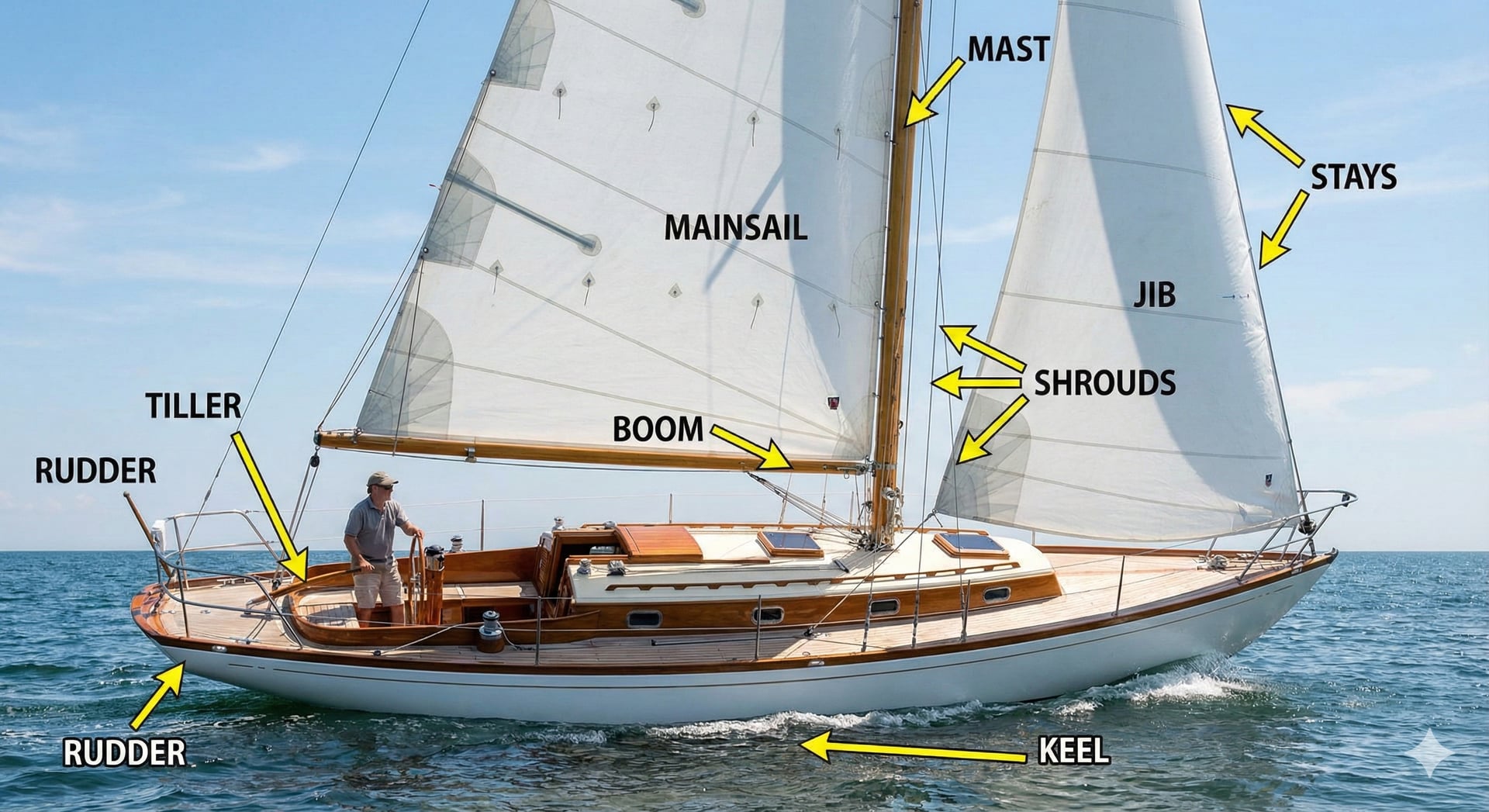
Sloop: The most common modern rig. It has one mast and two sails: a mainsail (aft of the mast) and a headsail (also called a jib or genoa, forward of the mast). It is simple and very efficient, especially when sailing upwind.
Cutter: A cutter also has one mast, but it is stepped (positioned) further aft. This allows it to fly two headsails at once: a staysail (on an "inner forestay") and a jib (on the "headstay"). This provides more sail combinations, making it a versatile and safe choice for heavy-weather, blue-water cruising.
Ketch vs. Yawl (The Classic Distinction): Both are two-masted rigs, with a shorter "mizzen mast" behind the mainmast.
- Ketch: The mizzen mast is stepped forward of the rudder post. The mizzen sail is large enough to add significant power
- Yawl: The mizzen mast is stepped aft of the rudder post. The mizzen sail is much smaller and used primarily for balance and trimming ("like an air rudder") rather than for propulsion
Schooner: A schooner has two or more masts, and the aft-most mast (mainmast) is taller than the foremast(s) (or they are all the same height). This is the opposite of a ketch or yawl.
Cabin Cruisers and Yachts
These terms refer to larger powerboats designed for accommodation and extended trips.
Cuddy Cabin: The smallest type of "cruiser." It is typically a 20-30 foot boat that looks like a runabout but has a small, enclosed cabin in the bow containing a V-berth (a bed) and often a portable toilet (porta-potti).
Cabin Cruiser: Generally, a powerboat from 25 to 45 feet with a larger cabin providing "liveaboard" amenities: a galley (kitchen), a head (bathroom with a toilet and shower), and one or more berths (sleeping quarters). These are designed for weekend or multi-day trips.
Yacht: This is a subjective term, not a formal classification. It simply implies a larger, more luxurious, and more capable vessel for extended voyages, typically over 40 feet in length. A "Motor Yacht" (MY) is power-driven, while a "Sailing Yacht" (SY) is sail-driven.
Commercial vs. Recreational Vessels (A Critical Legal Distinction)
This distinction has nothing to do with the size or type of boat and everything to do with its use.
Recreational Vessel: A vessel "being manufactured or operated primarily for pleasure."
Commercial Vessel: A vessel used for any business purpose, including carrying "passengers for hire."
Safety & Legal Application
The moment an operator accepts any form of compensation in exchange for taking someone on their boat, they are likely operating a commercial vessel. This includes friends "splitting gas" or a client "buying lunch."
This is a critical line to understand. Operating as a commercial vessel, even accidentally, makes an operator subject to entirely different and much stricter USCG requirements. This includes needing a USCG Captain's License (e.g., an "Operator of Uninspected Passenger Vessels" or "6-pack" license), and having more robust fire suppression systems, PFDs, and construction standards.
Federal Vessel Classification by Length
The U.S. Coast Guard's primary method for classifying recreational vessels is by their Length Overall (LOA). This classification system determines the minimum safety equipment (like fire extinguishers, PFDs, and sound-producing devices) that an operator is legally required to carry on board.
The length is measured from the tip of the bow to the stern in a straight line, excluding any attachments like anchor rollers, bowsprits, or outboard motors.
There are four main classes:
USCG Vessel Classifications by Length
| Class | Length Overall (LOA) | Common Examples | Primary Equipment Rules Affected | |:------|:---------------------|:----------------|:---------------------------------| | Class A | Less than 16 feet | PWCs, Jon boats, small sailboats | PFDs, Visual Distress Signals (day/night rules), Fire Extinguisher | | Class 1 | 16 feet to < 26 feet | Most runabouts, bowriders, center consoles | PFDs, VDS, Fire Extinguisher, Sound Signals (horn/whistle) | | Class 2 | 26 feet to < 40 feet | Cabin cruisers, larger center consoles | PFDs, VDS, Fire Extinguishers (multiple), Sound Signals (horn/whistle + bell) | | Class 3 | 40 feet to < 65 feet | Motor yachts, large sailboats | PFDs, VDS, Fire Extinguishers (multiple), Sound Signals (horn/whistle + bell) |
Note: Vessels 65 feet and longer fall under a different, more complex set of rules (e.g., for navigation lights) and are not typically covered in basic boating safety courses.
Summary
Understanding vessel types helps you recognize boats on the water, anticipate their capabilities and limitations, and communicate effectively with other boaters. The federal classification system by length is critical because it directly determines your legal equipment obligations. A Class A vessel has different requirements than a Class 2 vessel, and operating without required equipment subjects you to Coast Guard enforcement action and civil penalties.
The distinction between recreational and commercial operation is particularly important for anyone considering charter fishing, tour operations, or even casual "ride sharing" arrangements. The moment compensation enters the equation, federal commercial vessel requirements apply, including mandatory captain's licensing. Many well-meaning boaters have faced serious legal consequences for unknowingly crossing this line.
As you progress through this course, you'll learn the specific equipment requirements for each vessel class, enabling you to ensure full legal compliance regardless of what type of boat you operate.
Key Takeaways
- Personal Watercraft (PWC) lose steering when throttle is released-a critical safety hazard
- Vessel types range from PWC to yachts, each designed for specific uses and conditions
- Sailboat rigs (sloop, cutter, ketch, yawl, schooner) define sail configuration and capabilities
- Commercial vs. recreational status depends on use, not vessel type-any compensation triggers commercial requirements
- Federal vessel classes (A, 1, 2, 3) are based on length and determine equipment requirements
- Class A: < 16 feet; Class 1: 16-26 feet; Class 2: 26-40 feet; Class 3: 40-65 feet
- Operating commercially without proper USCG licensing is a serious federal violation