
Propulsion Systems
Introduction
Understanding how a boat is propelled is as important as understanding its hull. The propulsion system dictates speed, maneuverability, maintenance needs, and critical safety risks.
Outboard Motors
An outboard motor is a self-contained unit that includes the engine, transmission, and propeller, mounted directly to the boat's transom. The entire unit pivots to steer the boat (vector thrust) and can be trimmed up/down or tilted completely out of water.

2-Stroke vs 4-Stroke Engines
2-Stroke: Completes power cycle in two strokes. Oil mixed with gas for lubrication.
- Pros: Simple, lightweight, high power-to-weight, rapid acceleration
- Cons: Pollution (burning oil creates smoke), loud, poor fuel economy
- Modern DFI 2-strokes are cleaner but market shifted to 4-strokes
4-Stroke: Operates like car engine. Internal oil pan, not mixed with fuel.
- Pros: Quiet, clean (EPA compliant), excellent fuel efficiency
- Cons: Heavy, complex (valves, cams), requires oil changes
Inboard Engines
Inboard engines mount inside the hull with fixed prop shaft through bottom. Steering via separate rudder.
Direct Drive: Engine mid-ship, shaft runs straight back. Preferred for water skiing (small wake). Engine box occupies cockpit space.
V-Drive: Engine in stern facing backward, V-Drive gearbox redirects power forward. Creates large wake for wakeboarding. Opens cockpit space.
Pros: Rugged, protected from elements Cons: Fixed draft, propeller damage risk, poor reverse maneuverability (prop walk)
Stern Drives (I/O)
Hybrid system: inboard engine + outboard drive unit.
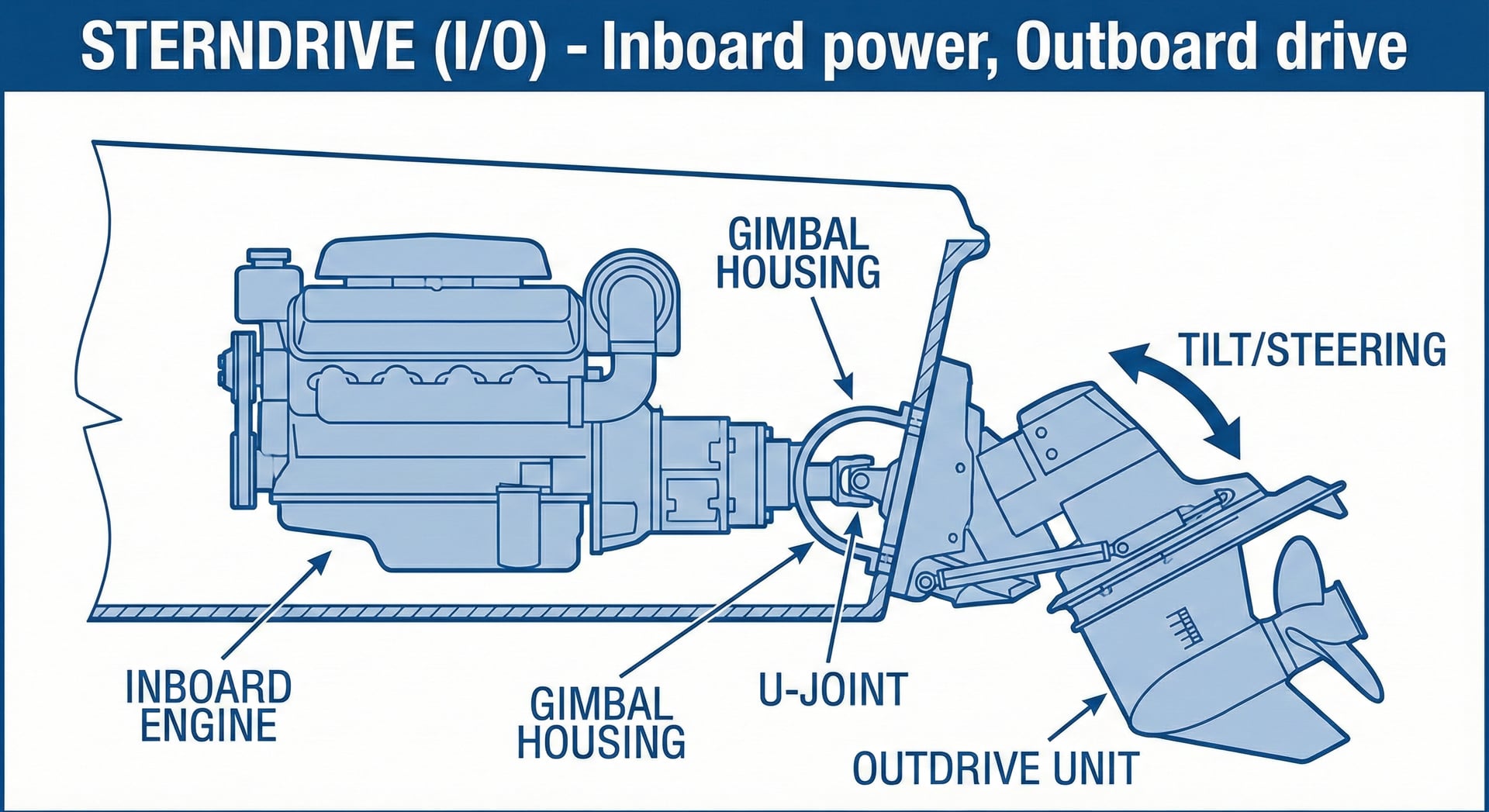
How it works: Engine inside attaches through transom to outdrive (transmission + propeller). Outdrive pivots for steering and trims up/down.
Pros: Best of both worlds - inboard power + outboard trim/steering Cons: High maintenance, saltwater corrosion, CRITICAL: Bellows failure can sink the boat (rubber seal between engine and drive)
Jet Drives
Propels by shooting high-velocity water jet out the back. Impeller sucks water through intake grate, forces out through steerable nozzle.

Pros: No propeller (extreme safety for swimmers), shallow draft, rapid acceleration Cons: CRITICAL SAFETY HAZARD: Off-throttle steering loss - if throttle released, jet stops and boat has NO steering control regardless of wheel position. Primary cause of PWC accidents. Also: clogs easily, inefficient.
Sail Propulsion Basics
Sails are airfoils (like airplane wings). Wind over curved sail creates low-pressure zone (Bernoulli). This generates lift pulling boat forward and sideways. Keel resists sideways motion, "squeezing" boat forward. No-go zone: ~45° either side of wind.
Electric/Hybrid Systems
Newest technology: combustion engine + electric motors + batteries. Three modes: electric-only (silent), engine-only (traditional), hybrid-boost (combined power). Pros: Environmentally friendly, quiet, instant torque Cons: High cost, battery weight