
Vessel Parts and Terminology
Introduction
Boating has its own language. This terminology is not meant to be confusing; it is designed to be precise, unambiguous, and universal. In an emergency, or even during simple docking maneuvers, there is no room for confusion. Using the correct terms is a core component of safe and effective operation.
Directional and Dimensional Terms
These are the most fundamental terms. They are absolute and do not change based on an operator's position or the direction they are facing.
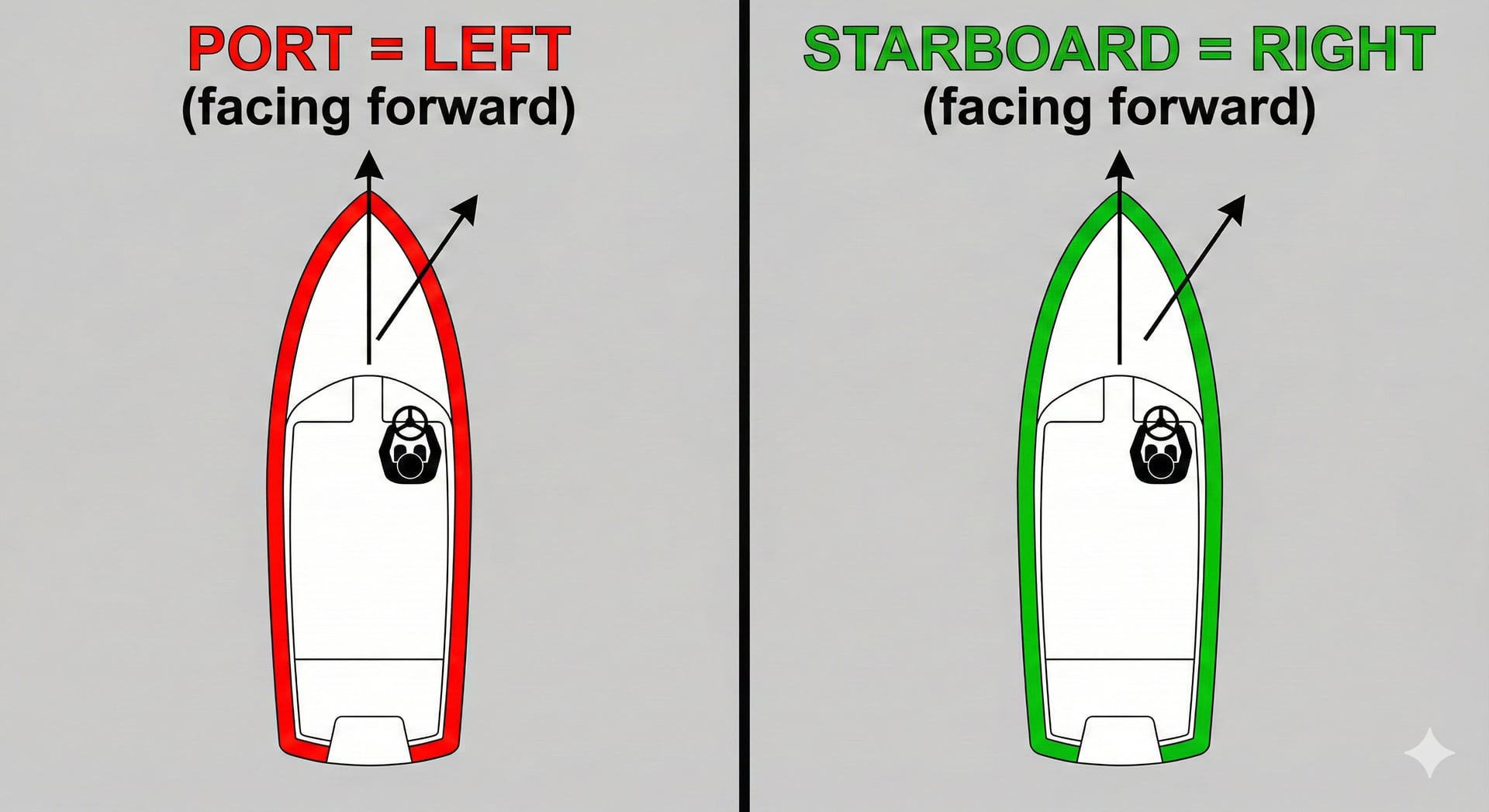
- Bow: The front of the vessel
- Stern: The rear (back) of the vessel
- Forward: Any movement toward the bow
- Aft: Any movement toward the stern
- Port: The left side of the vessel when an operator is facing the bow
- Starboard: The right side of the vessel when an operator is facing the bow

Safety Application: Why Not "Left" and "Right"?
"Left" and "right" are relative to the person. If an operator is in the cockpit facing the bow, their "left" is the port side. If that operator turns around to face the stern, their "left" is now the starboard side. This creates dangerous confusion. "Port" is always the port side, regardless of which way anyone is facing. This clear communication is essential for steering commands, docking, and collision avoidance.
Mnemonics (Memory Aids) for Port/Starboard:
- "Port" and "Left" both have four letters
- A good boater "left the port"
- Navigation light colors: "Port wine is red." The port side navigation light is always red. Starboard is green
Historical Origin
- Starboard: Comes from the Old English "stéor-bord" or "steering side." Early ships were steered with a large oar, always mounted on the right side for a right-handed helmsman
- Port: To avoid damaging the steering oar, ships would dock with their left side to the "port" or dock. This "loading side" was originally called "larboard," but it sounded too similar to "starboard" in a noisy storm and was officially changed to "port"
Dimensional Terms
- Beam: The vessel's maximum width at its widest point
- Draft: The vertical distance from the waterline (where the boat floats) to the lowest point of the vessel (usually the keel or the propeller). This is the minimum depth of water the boat needs to float without running aground
- Freeboard: The vertical distance from the waterline to the gunwale (the upper edge of the hull). This is the height of the boat's side out of the water. Low freeboard makes a boat "wet" and susceptible to swamping
- Waterline: The line painted or formed on the hull where the water surface rests when the boat is floating
External Anatomy (Parts of the Hull)

- Hull: The main structural body of the boat that provides buoyancy
- Deck: The flat, horizontal surface on top of the hull where people stand
- Keel: The central "backbone" of the vessel, running along the bottom of the centerline from bow to stern. It provides structural integrity and, on sailboats, lateral stability
- Transom: The flat, vertical surface at the stern of the boat. This is where an outboard motor is mounted or a sterndrive passes through
- Gunwale (pronounced "gunnel"): The upper edge of the hull's side, where the hull and deck meet
- Chine: The line or corner where the bottom of the hull meets the sides
- Hard Chine: A sharp, defined angle (common on planing hulls)
- Soft Chine: A smooth, rounded transition (common on displacement hulls)
- Cleat: The horn-shaped metal or plastic fitting securely bolted to the boat, used to tie off ropes (lines)
- Pulpit & Pushpit: A metal framework on the bow (pulpit) or stern (pushpit) of a boat (usually a sailboat) to provide safety for the crew
Interior Components (Inside the Boat)
- Cockpit: The open-air "command center" of the boat, where the helm is located and passengers sit
- Cabin: The enclosed, weatherproof living space below deck
- Companionway: The ladder or steps leading from the cockpit down into the cabin
- Bilge: The lowest internal compartment of the boat, beneath the cabin floor (the "sole")
- Safety Application: All water that leaks, rains, or sprays into the boat will collect in the bilge. A bilge pump is a critical piece of safety equipment used to pump this water out. A bilge that is filling with water indicates a leak
- Berth: A bed or sleeping area on a boat. A V-Berth is the berth located in the V-shape of the bow
- Head: The nautical term for the bathroom and/or toilet
- Galley: The nautical term for the kitchen or food-preparation area
- Salon (or Saloon): The main "living room" or social area within the cabin
- Bulkhead: The vertical walls or partitions inside a boat, which often provide structural support and separate cabins
Steering Systems: Tiller vs. Wheel
- Helm: This is the station where the boat is controlled. It includes the steering mechanism (tiller or wheel) and the engine controls
- Tiller: A simple lever attached directly to the top of the rudder post or to the outboard engine
- Operation: A tiller provides direct feedback from the water. It is "counter-intuitive" for beginners: to turn the boat to starboard (right), the operator must push the tiller to port (left)
- Uses: Small sailboats, dinghies, and small outboard engines
- Wheel: A car-style steering wheel that is not directly connected. It uses a system of mechanical cables, gears, or (on larger boats) hydraulics to move the rudder or engine
- Operation: Intuitive. "Turn the wheel right, the boat goes right."
- Uses: The standard on most recreational boats over 20 feet
Steering and Propulsion Components
- Rudder: On an inboard vessel, this is the vertical blade at the stern that deflects water to steer the boat. Crucial Application: A rudder only works when water is flowing over it. If a boat is dead in the water (not moving), it has no steerage
- Outboard Motor: A self-contained engine and propeller unit mounted on the transom. The entire unit pivots to steer the boat. This is called vector thrust and provides excellent maneuverability, even in reverse
- Sterndrive (I/O): The engine is inboard, but the drive unit (propeller) is outboard. Like an outboard, this drive unit pivots to steer the boat
- Inboard Engine: The engine is inside the hull, connected to a fixed propeller shaft. It cannot steer. It relies entirely on a separate rudder
Summary
Mastering nautical terminology eliminates confusion and enables precise communication in all boating situations. Understanding that "port" and "starboard" are absolute directional references prevents dangerous miscommunication during docking, anchoring, and navigation. Knowing the difference between the bow and stern, the helm and the cockpit, the bilge and the cabin demonstrates competence and professionalism.
This vocabulary extends beyond casual boating-it's the language used in navigation rules, Coast Guard regulations, marine weather forecasts, and emergency communications. When a Coast Guard officer instructs you to "display your throwable device from the port gunwale," or when a dockmaster directs you to "secure your stern line to the aft cleat," you must understand these terms instantly and act accordingly.
The terminology also reveals the rich maritime history underlying modern boating. "Starboard" reminds us of ancient steering oars; "port" recalls the practical need to protect that steering mechanism while docking; "head" derives from the location of early ship's toilets at the vessel's head (bow) where wave action provided natural flushing. This language connects today's recreational boaters to centuries of maritime tradition.
Key Takeaways
- Port (left) and starboard (right) are absolute directions that don't change based on observer position
- Bow (front) and stern (rear) define the vessel's primary axis
- Beam is width, draft is underwater depth, freeboard is height above water
- Hull components (keel, transom, gunwale, chine) describe structural elements
- Interior spaces (cockpit, cabin, bilge, berth, head, galley) have specific names and functions
- Tiller steering is counter-intuitive (push left to go right); wheel steering is intuitive
- Rudders require water flow to function; outboards and sterndrives use vector thrust
- Understanding this terminology is essential for safety, legal compliance, and professional communication