
Lesson 24 of 25 · 10 min
Kayaks, paddleboards and small boats
Carry the right gear, stay visible to powerboats, and get back in if you tip over.
24.1
Your kayak is a boat
Under Coast Guard rules, canoes, kayaks and paddleboards are vessels. The one exception is a paddleboard used inside a swimming, surfing or bathing area. Paddle past the swim zone and your board is a boat.
- The navigation rules apply to you. Paddlers get no special right of way.
- Florida doesn't require registering a canoe or kayak without a motor, at any length. Other boats without a motor are exempt if under 16 feet.
- Add a motor, even a small trolling motor, and FWC says it must be registered and titled.
Past the swim zone, a paddleboard is a boat.
24.2
What you must carry
- Life jacket: one Coast Guard approved wearable for each person, the right size and easy to reach. In Florida, children under 6 must wear one on any boat under 26 feet while it's underway.
- Sound: a whistle, horn or bell. FWC says it should be heard at least half a nautical mile away.
- After dark or in fog: a white light. A flashlight or lantern counts if it's ready at hand and you show it in time to prevent a collision.
- On the Atlantic, the Gulf and other coastal waters after dark: approved night distress signals. That means 3 approved flares, or 1 approved electric distress light.
Canoes and kayaks don't need the extra throwable cushion, even at 16 feet or longer.
Life jacket, whistle, and a white light after dark.
24.3
Wear it, and keep your gear on you
Kayaks and paddleboards tip over fast, often too fast to grab a life jacket. Wind or current can quickly push the boat away from you, along with anything stored on it. In 2024, 124 of the 143 U.S. paddlecraft deaths were drownings.
- Wear your life jacket the whole trip. Fishing life jackets are made to stay comfortable while you cast.
- Carry your whistle, a light and a phone in a waterproof case on your body, not in a hatch.
- Paddleboard? FWC suggests a leash so the board can't float away. In moving river current an ankle leash can snag. There, ACA advises a waist leash with a quick release.
Clip it to you, not to the boat.
24.4
Be seen, and stay out of the way
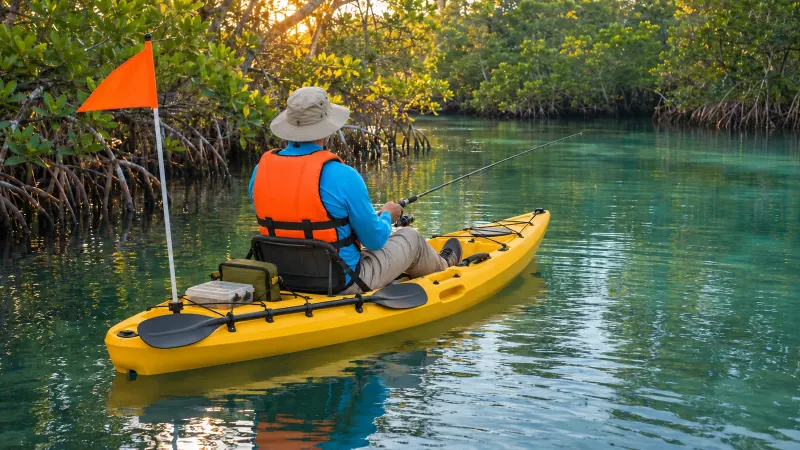
You sit low in the water. Chop, glare and fog hide you. Never assume a powerboat driver can see you.
- Wear a brightly colored life jacket and clothing. A bright boat, a kayak flag on a pole and reflective tape all help.
- Stay out of busy channels. Paddle near the edge, out of the path big boats use.
- In Florida, paddlecraft must stay out of the marked Intracoastal Waterway channel. You may cross it quickly and directly. If it's the only open water, you may use it, but leave it as soon as you safely can. Emergencies are excepted too.
- Cross a channel straight across, as a group.
- Meeting a boat head-on? Turn right. Being passed? Hold your course.
Assume they can't see you.
24.5
Wind, tide and the trip home
Wind, current and tide can make it very hard to get where you're going, or back.
- Start into the wind or current, so the tired trip home is the easy direction. Or paddle one way downwind, with a car waiting at the end.
- Check the marine forecast and the tides before you go (Skill 15).
- Florida water can still be cold enough to shock you, especially in winter (Skill 20). Dress for the water, not the air.
- Paddle with a partner, and leave a float plan with someone ashore.
Go out against the wind. Ride it home.
24.6
If you tip over
Tipping over is a normal part of paddling. Be ready to swim.
- Hold on to your boat and paddle. Don't let the wind take them.
- Get back in. On a sit-on-top kayak or paddleboard, climb back on with your weight low. In a sit-inside kayak, learn the wet exit and a paddle-float re-entry from an instructor. Pump out the water.
- Can't get back in? Stay with the boat. It floats, and it's easier to spot than a head. Signal for help.
Practice in shallow, calm water with all your fishing gear aboard. And put your name and phone number inside the boat. An empty kayak with no name can start a search for someone who isn't missing.
Practice getting back in before you need to.
24.7
Kayak fishing: stable first, fish second
Spills often start with something simple: standing up to cast, or reaching or leaning out.
- Keep your weight low and centered. Stow and tie down your gear so it can't shift.
- Our advice: stay seated to land a big fish. Bring it close to net it, instead of leaning out.
- Look around before you cast. Handle hooks carefully. A hook that's deep, or in the face or near an eye, needs a doctor.
- Carry a knife where you can reach it, to cut a tangled anchor or fishing line.
- Anchoring a kayak takes practice. A line that's too short can pull the boat under. Our advice: practice in calm water before you try it in current.
Sit down to land the fish.
24.8
Getting into a canoe or small boat
Canoes, jon boats and small skiffs tip easily at the dock.
- Hold the dock or have someone steady the boat.
- Step into the middle, staying low. Never step on the edge.
- One person at a time. Have gear handed in after you're seated.
- Keep weight balanced side to side and front to back. Keep three points of contact when you move.
The driver should say before turning or speeding up. And don't overload: count people, coolers and gear.
Step into the middle and stay low.
Try it
Take the driver's seat. Can you spot the paddler?
You're driving · 18-ft center console
Set the conditions, then glance. A kayak is somewhere ahead; tap where you see it.
No glances yet.
Simplified: the scene shows the idea, not a measurement. Paddlers must have a white light after dark.
National Park Service, Point Reyes: Your safety while boatingFWC: Human-powered vessels (canoes, kayaks, paddleboards)NASBLA ESP TR 101-2022 (human-propelled technical report) (6.5.1)
Watch, then try
Getting back on: watch it, then put the steps in order.
Climb back on with your weight low. Your gear stays tied down.
Simplified drawings: practice with an instructor in shallow, calm water.
Step 1 of 3Hold on to your kayak and paddle. Don't let the wind take them.
Can't get back on? Stay with the boat. It floats, and it's easier to spot than a head. Signal for help.
NASBLA ESP TR 101-2022 (human-propelled technical report) (7.7.2)National Park Service, Pictured Rocks: Kayak guide task book v2National Park Service, Point Reyes: Your safety while boatingFWC: Rental safety information
Your turn
8 decisions8 real situations. Decide first, then read why.
These come back for review later, because remembering on the water is what counts.
A day on the water
1 story tripUse it on a whole day out.
Story trips from the morning forecast to the ride home. You make the calls; a bad one plays out so you see why the rule exists.
Sources
Checked 2026-11-05- 1USCG Recreational Boating Statistics 2024U.S. boating deaths, causes and life jacket use2024 report (latest national; 2025 due Oct 31, 2026)
- 2FWC Boating Accident Statistical Report 2025Florida boating accidents, causes and deaths2025 report, retrieved 2026-11-05
- 3FWC: Human-powered vessels (canoes, kayaks, paddleboards)Paddleboards outside swim, surf or bathing areas are vessels; life jacket, sound device heard 1/2 nautical mile, white light at night, coastal night distress signals; motorized paddlecraft must be registered and titled; be visibleWeb page (myfwc.com blocks automated readers; read via Internet Archive copy dated May 10, 2026), checked Nov 5, 2026
- 4Fla. Stat. 328.48Which boats must be registered, and where the number and decal go2026 Florida Statutes
- 5USCG Navigation Center: Navigation Rules FAQ (question 13)Kayaks and canoes are vessels under oars; three lighting options at night; no automatic right of wayUndated web page, checked Nov 5, 2026
- 6NASBLA ESP TR 101-2022 (human-propelled technical report)Capsizes happen too fast to put on a life jacket; wind and current separate you from the boat; never assume you are seen; cross channels straight and together; hold onto boat and paddle; "If Found" stickersPublication Version Jun 1, 2022 (checked Nov 5, 2026)
- 7ANSI/NASBLA 101-2022 (Plus Human-Propelled)National standard for paddlecraft: wear life jackets, gear on your person, owner marking, boarding, no special right of way, capsize response, cold water, fishing from paddlecraftEffective Jun 1, 2022 (checked Nov 5, 2026)
- 833 CFR 175 Subpart BLife jackets every boat must carryeCFR, current through Oct 22, 2026
- 9Fla. Stat. 327.50Required safety equipment; children under 6 must wear a life jacket on boats under 26 feet2026 Florida Statutes
- 1033 CFR 83.33 (Rule 33)Horns, whistles and bells boats must carryeCFR, current through Oct 22, 2026
- 1133 CFR 83.25 (Rule 25)Lights for sailboats and boats under oars or paddleeCFR, current through Oct 22, 2026
- 1233 CFR 175 Subpart CDistress signals (flares, flag, light) on coastal waterseCFR, current through Oct 22, 2026
- 13American Canoe Association: Kayak fishing safety tipsA fishing life jacket, check wind, weather and tides, deep-water re-entry, float planUndated one-page PDF (checked Nov 5, 2026)
- 14American Canoe Association: SUP leashesA leash keeps you with your board in most places; in moving rivers it can snag, so use a waist leash with a quick release reachable with both handsUndated one-page PDF (checked Nov 5, 2026)
- 15National Park Service, Point Reyes: Your safety while boatingKayaks sit low and are hard to see; bright colors, a kayak flag and a light after dark; be able to re-enter; stay with a capsized boatLast updated Jun 27, 2024 (checked Nov 5, 2026)
- 16Fla. Stat. 327.371Paddlecraft in the marked Intracoastal Waterway channel2026 Florida Statutes
- 17American Canoe Association: Recreational kayaking safety essentialsBright clothing, reflective tape and a white light; avoid where big boats travel; cross channels straight acrossOne-page placard, 2010 (checked Nov 5, 2026)
- 18American Canoe Association: Stand up paddleboarding safetyPaddle into the wind first, or arrange a pickup downwind; know the tides; know when to wear a leash; life jacket with whistleUndated one-page placard (checked Nov 5, 2026)
- 19FWC: Rental safety informationPersonal watercraft: stopping the engine stops steering; no brakes; intake grate and jet nozzle injuries; following, spraying and wake jumping. Paddlecraft: stay low, wind and current, stay with the boatWeb page (myfwc.com blocks automated readers; read via Internet Archive copy dated Apr 20, 2026), checked Nov 5, 2026
- 20NWS: Cold water hazardsCold shock can start in water as warm as 77°FWeb page, checked Oct 25, 2026
- 21National Park Service, Pictured Rocks: Kayak guide task book v2Open-water self-rescue skills: wet exit, paddle float self-entry, scramble self-entry, pumping out, staying with kayak and paddleVersion 2, undated PDF (checked Nov 5, 2026)
- 22NASBLA ESP TR 103 (technical report)Guidance for teaching the national boating standard: trailering, docking, anchoring, boarding, stormsVersion 1.0, June 2022 (guidance, not a rule)
- 23National Park Service: Reel it in (fishing safety)Look around before you cast; handle hooks carefully; get medical care for deep hooks or hooks near the eyeLast updated Aug 7, 2020 (checked Nov 5, 2026)
- 24NWS Glossary: Small Craft AdvisoryThere is no precise definition of a small craft; any boat that may be adversely affected should be considered oneWeb glossary, checked Nov 5, 2026
Checked against these sources on November 5, 2026.
Free practice lessons, not an FWC-approved course: they don't issue the Florida Boating Safety Education ID Card. Covers national standard topics C3.1, C3.2, C3.3, C4.1, C5.4, C6.1, C8.2, H3.4.1, H3.4.2, H3.4.3, H4.11.1, H4.11.5, H5.6.1, H5.6.3, H5.6.7, H6.5.1, H6.5.2, H7.7.2, H7.7.3, H7.7.4, H8.3.1 and Florida rule 68D-36.104 (2)(c), (2)(f).