
Lesson 23 of 25 · 10 min
Jet skis (personal watercraft)
Ride a jet ski legally in Florida, steer out of trouble, and get back on after a fall.
23.1
Florida law for every ride
In Florida law, a jet ski is a personal watercraft. That's a boat under 16 feet, pushed by a water jet. You ride sitting, standing or kneeling on it, not inside it.
- Age: you must be at least 14 to drive one. An owner who lets a younger child drive breaks the law too.
- Life jackets: everyone aboard, and anyone towed, wears a Coast Guard approved life jacket that is not inflatable.
- Lanyard: if the jet ski has a cut-off lanyard, clip it to your body, clothes or life jacket.
- Hours: no riding from half an hour after sunset to half an hour before sunrise, even with lights. In the half hours just after sunset and before sunrise, you must show navigation lights.
- Boater ID: born on or after January 1, 1988? With a motor of 10 horsepower or more, carry your Boating Safety Education ID Card and a photo ID.
14 to drive. Lanyard on. No inflatables. Daylight only.
23.2
It's a boat: every rule applies
A jet ski is a power-driven vessel, just like a bay boat. Every rule in this course applies to it:
- Keep a lookout all around, not just ahead.
- Give way by the same rules (Skill 4), and keep a safe speed.
- Obey Idle Speed, Slow Speed and manatee zone signs.
In Florida, breaking the federal navigation rules also breaks state law. In 2025, the top causes of Florida jet ski accidents were inexperience and no proper lookout.
Same water, same rules.
23.3
No throttle, no steering
A pump inside pulls in water from under the hull. It shoots the water out a nozzle at the back. Turning the handlebars swings the nozzle. No thrust, no turn: let go of the throttle and many jet skis keep going straight.
That's why panicked riders hit the thing they're trying to miss. If something is in your way, keep some throttle on while you turn.
Some newer models have off-throttle steering, brakes or reverse. They work differently on each model, so learn yours from the owner's manual before you ride.
To turn, you need throttle.
23.4
Stopping takes room
A jet ski has no brakes like a car. Shutting the engine off doesn't stop it. It keeps sliding forward, and you lose steering too.
- At speed, a jet ski can travel a long way before it stops.
- If yours has a brake or reverse, check that nobody is right behind you before you use it.
- Reverse is slow and clumsy. Shift into it only when you're almost stopped.
So slow down early: well before docks, ramps, swimmers and other boats. Near a dock, come in at idle and steer with short bursts of throttle.
Slow down early. A jet ski coasts.
23.5
Wakes, tailgating and spraying
Florida law calls these jet ski moves reckless operation, a crime:
- Weaving through crowded boat traffic.
- Jumping another boat's wake too close to it, or where you can't see around it.
- Swerving at the last second to miss a collision.
FWC says following close behind a boat is unsafe and against the law. So is spraying a boat or person, or turning sharply in front of others. Jumping waves and wakes can also cause back and spine injuries, broken bones and face injuries.
In 2025, nearly half of Florida's jet ski accidents were crashes with another boat (72 of 161).
Never jump a wake close behind a boat.
23.6
The jet pump can hurt people
The intake grate under the hull sucks in water hard. Long hair, loose clothes, life jacket straps and tow ropes can get pulled in. The nozzle at the back fires a jet that can injure anyone behind it. It can also throw sand and stones.
- Before you start, check that nobody is near the intake or behind the nozzle.
- Never give throttle with anyone at the back.
- If someone is in the water near you, boarding, or clearing weeds: engine off and lanyard out.
- Don't ride in shallow water. Stop out where it's deep enough and walk the jet ski in to the beach.
Engine off, lanyard out, before anyone gets near the back.
23.7
Falling off, flipping and getting back on
With the lanyard clipped on, the engine stops when you fall off. Swim to the jet ski.
- Flipped over? Look for the decal on the back. It shows which way to roll it upright. Never try to start it upside down.
- Getting back on: climb on from the back, using the step or handhold. Keep the engine off until everyone is seated. Then help passengers on.
- Passengers: one seat for each person, and no more than the manual allows. Jet skis don't need a capacity plate. Tell riders before you turn, and avoid sharp turns.
- Rough water: meet waves with the front of the jet ski, and keep moving. Slow down gradually so your own wake doesn't flood the foot area.
Practice getting back on in calm water near shore, with an experienced rider.
Climb on from the back, with the engine off.
23.8
Renting a jet ski in Florida
- You must be 18 to rent a jet ski. A rider aged 14 to 17 may drive a jet ski an adult rented. They need the briefing. By law, they also need a boater ID card or other accepted proof, plus photo ID.
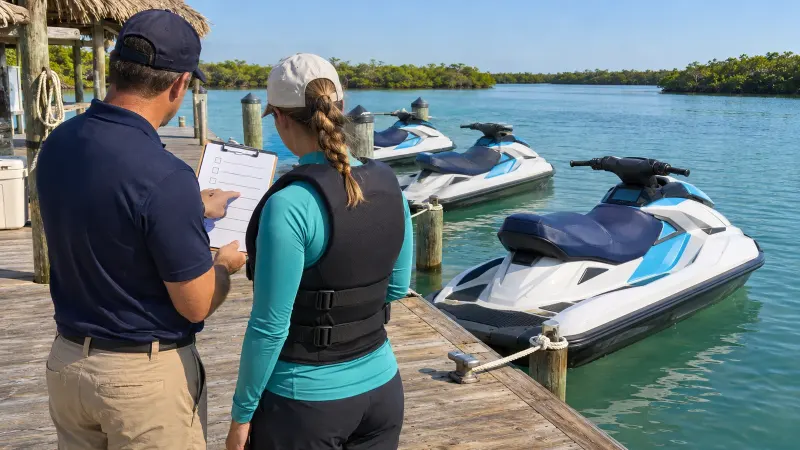
- The rental business must teach every renter and every person who may drive before the ride. That includes the jet ski's controls, local hazards and zones, and what to do if you fall off or flip. You sign a form saying you got it.
- For motorized rentals, they must also watch you ride in a short on-the-water check ride.
- Born on or after January 1, 1988? Show your boater ID card. This course is practice, not the card.
- Bring it back on time. If you're more than 4 hours overdue, the business must call law enforcement.
Ask where you may ride, where the manatee and speed zones are, and how this model steers and stops.
Every driver gets the briefing first.
Try it
No throttle, no steering. Feel it before you ride.
A jet ski steers with its jet. No throttle, no turn. Try it.
20 mph (17.8 kn) · dock 151 ft · jet on, 75%
Keyboard: ← → steer while held · ↑ ↓ throttle. Lever 75%.
You're riding at about 20 mph. A dock is ahead. Steer around it.
Simplified: not any real jet ski. Some newer models have off-throttle steering, brakes or reverse. They work differently on each model, so learn yours from the owner's manual before you ride.
NASBLA ESP TR 103.1-2022 (water-jet technical report), sections 2.5.2 and 5.6.6FWC: Rental safety information
Your turn
8 decisions8 real situations. Decide first, then read why.
These come back for review later, because remembering on the water is what counts.
A day on the water
1 story tripUse it on a whole day out.
Story trips from the morning forecast to the ride home. You make the calls; a bad one plays out so you see why the rule exists.
Sources
Checked 2026-11-05- 1FWC Boating Accident Statistical Report 2025Florida boating accidents, causes and deaths2025 report, retrieved 2026-11-05
- 2Fla. Stat. 327.02Florida definitions: personal watercraft, motorboat, airboat, canoe, length, vessel2026 Florida Statutes (checked Nov 5, 2026)
- 3Fla. Stat. 327.39Personal watercraft: life jackets, lanyard, age 14, no riding at night, reckless maneuvers2026 Florida Statutes
- 4FWC: Florida boating regulations (summary)Personal watercraft and water ski rules; navigation lights needed in the twilight half hours; breaking federal navigation rules also breaks Florida law; boaters who accidentally strike a manatee are urged to report it to FWC and may not be prosecuted if they were obeying speed rules; accident reporting summaryWeb page "up to date as of July 2025" (myfwc.com blocks automated readers; read via Internet Archive copy dated Oct 25, 2026), checked Nov 5, 2026
- 5Fla. Stat. 327.395Who needs a Boating Safety Education ID Card, accepted proof and exemptions2026 Florida Statutes
- 633 CFR 83.03 (Rule 3)Definitions, including "engaged in fishing" (trolling doesn't count)eCFR, current through Oct 22, 2026
- 7NASBLA ESP TR 103.1-2022 (water-jet technical report)Jet drives need thrust to steer; braking and reverse vary; long stops; intake and nozzle injuries; engine off and link removed near people; walk it in to the beach; take waves bow-on; right a capsized jet ski by its decalPublication Version Jun 1, 2022 (checked Nov 5, 2026)
- 8ANSI/NASBLA 103.1-2022 (Water-Jet Supplement)National standard for jet skis and jet boats: how jet drives work, loading, controls, intake and jet wash, docking and beaching, capsizing and rightingEffective Jun 1, 2022 (checked Nov 5, 2026)
- 9NASBLA ESP TR 103 (technical report)Guidance for teaching the national boating standard: trailering, docking, anchoring, boarding, stormsVersion 1.0, June 2022 (guidance, not a rule)
- 10FWC: Rental safety informationPersonal watercraft: stopping the engine stops steering; no brakes; intake grate and jet nozzle injuries; following, spraying and wake jumping. Paddlecraft: stay low, wind and current, stay with the boatWeb page (myfwc.com blocks automated readers; read via Internet Archive copy dated Apr 20, 2026), checked Nov 5, 2026
- 11Fla. Stat. 327.33Reckless and careless operation2026 Florida Statutes
- 12Fla. Stat. 327.54Boat and jet ski rentals: renter age, pre-ride instruction, and calling law enforcement when a rental is more than 4 hours overdue2026 Florida Statutes
- 13F.A.C. 68D-34.002What a livery must teach every renter and potential operator before the ride; on-the-water check ride for motorized rentals; signed formEffective Aug 4, 2024 (Cornell LII copy; flrules.org returned error 522 on Nov 5, 2026)
- 14FWC: Livery regulations and safety informationAll renters and all potential operators get pre-rental and pre-ride instruction; signed forms kept 90 days; boater education proof for rentersWeb page (myfwc.com blocks automated readers; read via Internet Archive copy dated Jul 10, 2026), checked Nov 5, 2026
- 15Fla. Stat. 327.331Divers-down flags and buoys; distances boats must keep2026 Florida Statutes
Checked against these sources on November 5, 2026.
Free practice lessons, not an FWC-approved course: they don't issue the Florida Boating Safety Education ID Card. Covers national standard topics C5.2, C6.1, C8.1, P3.4.4, P8.3.1, J2.5.2, J2.5.3, J2.5.4, J5.6.4, J5.6.5, J5.6.6, J7.7.2, J7.7.3 and Florida rule 68D-36.104 (2)(a), (2)(b), (2)(d), (2)(g), (2)(k), (2)(l).