
Lesson 22 of 25 · 9 min
Protect the water
Keep sewage, trash and line out of the water, spare the seagrass, and help hurt wildlife.
22.1
Sewage: nothing raw goes over
Raw sewage may never be dumped from a boat in Florida waters.
- Built-in toilet? It must connect to a Coast Guard-certified marine sanitation device (MSD). Types I and II treat the waste. Type III is a holding tank.
- If a toilet or tank can flush straight overboard, lock that valve shut in Florida waters. Use a padlock, a wire tie that can't be undone, or remove the handle.
- Empty a holding tank only at a pumpout station. Empty a portable toilet at a dump station ashore.
A boat 26 feet or longer with a cabin and bunks must have a toilet. It can be a portable one.
Holding tank? Pumpout only.
22.2
No-discharge zones: not even treated
In a no-discharge zone, no sewage may go overboard, treated or not. Secure Type I and II devices too, the same way.
Florida's no-discharge zones:
- state waters of the Florida Keys National Marine Sanctuary,
- the waters of the City of Key West,
- Destin Harbor, and
- the Indian River–Vero Beach to Fort Pierce Aquatic Preserve, in the Indian River Lagoon (added in 2024).
Outside these zones, a working Type I or II device may discharge treated waste. Raw sewage is still banned in all Florida waters.
In a no-discharge zone, nothing goes over.
22.3
Trash and oil: bring it all back
- Plastic: never overboard, anywhere. That includes old line, nets and bags.
- Any garbage (food, cans, bottles, paper) is illegal to dump in U.S. navigable waters. That covers Florida's bays, rivers and lakes, and the ocean near shore.
- Oily bilge water: never pump it overboard. Soak it up with pads or catch it in a bucket, and dispose of it ashore. A sheen is reported, never hidden with soap. Skill 13 covers spills.
Boats 26 feet or longer must post two placards:
- A garbage placard, at least 8 by 5 inches, where crew and passengers can read it.
- A 5-by-8-inch "Discharge of Oil Prohibited" placard in the engine space or at the bilge pump switch.
Secure trash so the wind can't take it, and pick up litter you find.
Plastic never. Trash never. Oil never.
22.4
Fishing line and lost gear
Line, hooks and nets left in the water can tangle and kill sea turtles, birds and dolphins. Loose line wraps propellers too.
- Never leave line or gear behind. Check your line often so it doesn't break off.
- Recycle it. Florida has more than 1,600 line recycling bins at ramps, piers, marinas and tackle shops.
- Don't toss bait scraps or fish remains near turtles or dolphins. They learn to hang around boats and hooks.
- Turtles or dolphins after your bait? Move to another spot, and don't cast near them.
Reel it in, remove it, recycle it.
22.5
Seagrass and coral: read the water
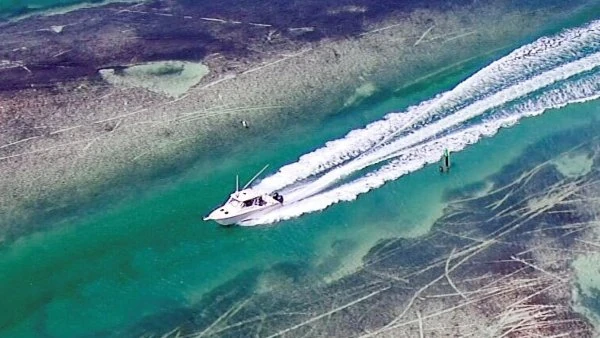
Florida's seagrass is a nursery for trout, redfish, crabs, shrimp and scallops. Manatees and sea turtles eat it. Propellers, anchors and groundings tear it up.
- Too shallow? Trim up, slow down, or go around. Don't power through rooted plants.
- Anchor in bare sand, not on grass or coral (Skill 17).
- In an aquatic preserve, careless running outside a marked channel that scars seagrass is a violation (Skill 16).
- In the Florida Keys sanctuary, it's illegal to scar seagrass, hit coral or churn the bottom with your propeller.
Boaters can also be billed for the cost of repairing the damage. Run aground anyway? Skill 9 shows how to get off without more harm.
Too shallow to run? Trim up, slow down, or go around.
22.6
Hit a manatee or hooked a turtle?
Manatees and sea turtles are protected by Florida and federal law. Harassing, feeding or disturbing them is illegal. Obey manatee zone signs, and wear polarized glasses to see into the water.
Hit a manatee? Report it to FWC right away: 888-404-3922, or #FWC or *FWC on a cell phone. FWC says boaters who were following the speed rules may not be prosecuted.
Hooked a sea turtle?
- Call for help. Don't yank it up by the line.
- If you can, bring it aboard with a net, or lift it by the shell. Keep hands away from its mouth and flippers.
- Cut the line, leaving at least 2 feet. Leave the hook in for trained responders.
- Can't get help or bring it in? Cut the line as short as you can, and let it go.
Report injured, tangled or dead turtles and manatees to the same FWC number.
Hit or hooked? Call FWC: 888-404-3922.
22.7
Give wildlife room
NOAA's viewing guidelines for the Southeast:
- Dolphins and sea turtles: stay at least 50 yards away, half a football field.
- Whales: at least 100 yards. For North Atlantic right whales, 500 yards is the law.
- Watch for 30 minutes or less. Never chase, circle or trap animals between boats or against the shore.
- One comes to you? Put the engine in neutral and let it pass.
- A group of dolphins ahead? Slow down and cross behind them, not through them.
50 yards. Neutral if they come close.
22.8
Invasive species: more than the trailer
Skill 14 covers clean, drain, dry at the ramp. Out on the water:
- Drain your livewell, baitwell and bilge before you leave a waterway, not at the next one.
- Never dump leftover bait or bait water into another lake or river. Put unused bait in the trash.
- Never release a pet fish, aquarium plant or any animal not native to Florida. It's illegal in Florida without FWC permission, and banned in the Keys sanctuary.
Why it matters to you: invasive plants and animals can foul propellers, jam engine water pumps and clog bilge pumps.
Drain it here. Trash the bait. Release nothing.
Try it
Can this go overboard here?
2 · Where? Tap a place on the map
Now tap a place on the map: raw sewage there?
Every answer as a table
| Item | Bay, river or Gulf near shore | No-discharge zone |
|---|---|---|
| Raw sewage | Never (Fla. Stat. 327.53). | Never (Fla. Stat. 327.53). |
| Treated sewage (Type I/II) | Allowed here, from a working Type I or II device. | NeverNo: no-discharge zone. |
| Holding tank (Type III) | Pumpout or ashore onlyPumpout only. | Pumpout or ashore onlyPumpout only. |
| Portable toilet | Pumpout or ashore onlyEmpty it ashore. | Pumpout or ashore onlyEmpty it ashore. |
| Plastic | Never, anywhere (33 CFR 151.67). | Never, anywhere (33 CFR 151.67). |
| Food scraps | NeverNo: U.S. navigable waters (33 CFR 151.66). | NeverNo: U.S. navigable waters (33 CFR 151.66). |
| Cans and bottles | NeverNo: U.S. navigable waters (33 CFR 151.66). | NeverNo: U.S. navigable waters (33 CFR 151.66). |
| Oily bilge water | Never. Pads, bucket, dispose ashore. | Never. Pads, bucket, dispose ashore. |
| Fishing line | Never, anywhere (33 CFR 151.67). | Never, anywhere (33 CFR 151.67). |
Put it in order
You hooked a sea turtle. What now?
You hook a sea turtle. Put the four steps in order.
Cards
Your order
- Step 1
- Step 2
- Step 3
- Step 4
Tap a card to make it the next step, or drag it by its handle. Five cards, four steps: one card is a mistake.
NOAA Fisheries: Fishing tips to protect sea turtles and marine mammalsFWC: Sea Turtle ProgramFWC: Wildlife Alert hotline
Your turn
8 decisions8 real situations. Decide first, then read why.
These come back for review later, because remembering on the water is what counts.
A day on the water
1 story tripUse it on a whole day out.
Story trips from the morning forecast to the ride home. You make the calls; a bad one plays out so you see why the rule exists.
Sources
Checked 2026-11-05- 1FWC: Seagrass FAQProp scars take months or years to recoverUndated web page
- 2Fla. Stat. 327.53Toilets and sewage: no raw sewage in Florida waters2026 Florida Statutes
- 333 CFR 159.3 and 159.7Marine sanitation device types (Type III is a holding tank); boats with installed toilets need a certified MSD; how to secure a device where discharge is prohibitedeCFR, current through Nov 3, 2026 (checked Nov 5, 2026)
- 440 CFR 140.4Complete sewage discharge prohibitions, including state waters of the Florida Keys National Marine SanctuaryeCFR, current through Nov 3, 2026 (checked Nov 5, 2026)
- 5EPA: No-discharge zones by stateFlorida no-discharge zones: Destin Harbor, City of Key West waters, Florida Keys sanctuary state waters, Indian River Lagoon (Vero Beach to Fort Pierce Aquatic Preserve, 2024)Last updated Sep 22, 2026 (checked Nov 5, 2026)
- 6USCG: A Boater's Guide to the Federal RequirementsLoading, anchoring, fueling, float plans and checklistsRevised Nov 2023
- 715 CFR 922.163Florida Keys National Marine Sanctuary: no prop-scarring or striking coral or seagrass; no prop-dredging; no anchoring on living coral in under 40 ft when the bottom is visible; MSDs must be secured; no releasing exotic specieseCFR, current through Nov 3, 2026 (checked Nov 5, 2026)
- 833 CFR 151.67No plastic overboard at sea or in U.S. navigable waterseCFR, current through Oct 22, 2026
- 933 CFR 151.66(a)No garbage of any kind may be discharged into the navigable waters of the United StateseCFR, current through Nov 3, 2026 (checked Nov 5, 2026)
- 1033 CFR 151.51 and 151.59U.S. boats 26 ft or longer must post a garbage placard at least 8 by 5 inches; oceangoing boats 40 ft or longer with a galley and berthing need a written garbage planeCFR, current through Nov 3, 2026 (checked Nov 5, 2026)
- 1133 CFR 155.450Boats 26 ft or longer must post a 5 by 8 inch "Discharge of Oil Prohibited" placard in the machinery space or at the bilge pump controleCFR, current through Nov 3, 2026 (checked Nov 5, 2026)
- 1240 CFR Part 110An oil or fuel discharge that leaves a sheen is a harmful discharge; adding chemicals to hide it is prohibited; notify the National Response CentereCFR, current through Nov 2, 2026 (checked Nov 5, 2026)
- 13FWC: How boaters can conserveNever litter and pick up litter; avoid shallows your motor will stir up; don't power through rooted aquatic plants; mind your wakeWeb page (read via archive copy dated Jun 16, 2026), checked Nov 5, 2026
- 14FWC: Monofilament Recovery and Recycling ProgramReel, remove, recycle; over 1,600 fishing line recycling bins at Florida ramps, piers, marinas and tackle shopsWeb page (read via archive copy dated Jul 15, 2026; myfwc.com blocks automated readers), checked Nov 5, 2026
- 15NOAA Fisheries: Fishing tips to protect sea turtles and marine mammalsNever abandon gear; recycle line; move if turtles or dolphins show interest; if you hook a turtle: call for help, net or lift by the shell, cut the line leaving 2 ft, leave the hook; give animals 50 yards, cross behind dolphins, neutral if closeLast updated Sep 20, 2024 (checked Nov 5, 2026)
- 16Florida Sea Grant SGEB 73: Boating and Angling Guide to Biscayne BayAnchor only in bare sandy bottoms; use mooring buoys instead of anchoring on reefs; seagrass damage in aquatic preserves is a violationUniversity of Florida / Florida Sea Grant map guide, revised for accessibility Apr 23, 2026 (checked Nov 5, 2026)
- 17Fla. Stat. 253.04(3)Careless operation outside a marked channel that scars seagrass in an aquatic preserve is a boating violation2026 Florida Statutes (Florida Senate site), checked Nov 5, 2026
- 18Fla. Stat. 379.2431Protection of manatees and sea turtles2026 Florida Statutes
- 19FWC: Florida Manatee ProgramManatees are protected by Fla. Stat. 379.2431(2) and the federal Marine Mammal Protection and Endangered Species Acts; report distressed or dead manatees to 888-404-3922, #FWC or *FWCWeb page (read via archive copy dated Oct 25, 2026), checked Nov 5, 2026
- 20FWC: Florida boating regulations (summary)Personal watercraft and water ski rules; navigation lights needed in the twilight half hours; breaking federal navigation rules also breaks Florida law; boaters who accidentally strike a manatee are urged to report it to FWC and may not be prosecuted if they were obeying speed rules; accident reporting summaryWeb page "up to date as of July 2025" (myfwc.com blocks automated readers; read via Internet Archive copy dated Oct 25, 2026), checked Nov 5, 2026
- 21FWC: Sea Turtle ProgramBoat strikes and fishing gear harm sea turtles; "To report … an injured, dead or harassed sea turtle, call Wildlife Alert at 888-404-FWCC (3922) or report it online. Cell phone users can also call *FWC or #FWC."Web page read directly on Nov 5, 2026 (also archive copy dated Oct 25, 2026)
- 22FWC: Wildlife Alert hotlineReport fishing, wildlife or boating violations: 888-404-3922Web page (read via archive copy, Oct 2026)
- 23NOAA Fisheries: Southeast U.S. marine mammal and sea turtle viewing guidelinesRecommended distances: dolphins 50 yards, sea turtles 50 yards, whales 100 yards (right whales 500 yards by law); 30 minutes or less; neutral if approached; never chase, encircle or trap2014 brochure (distances match NOAA's current fishing-tips page), checked Nov 5, 2026
- 2450 CFR 224.103(c)Stay at least 500 yards from North Atlantic right whaleseCFR, current through Oct 22, 2026
- 25NASBLA ESP TR 103 (technical report)Guidance for teaching the national boating standard: trailering, docking, anchoring, boarding, stormsVersion 1.0, June 2022 (guidance, not a rule)
- 26USFWS: Protect your watersClean, drain and dry before leaving the water; bait in the trash; never move live fish between watersUpdated Sep 21, 2026 (checked Nov 5, 2026)
- 27Fla. Stat. 379.231Releasing any animal not native to Florida is illegal unless FWC authorizes it2026 Florida Statutes (flsenate.gov, checked Nov 5, 2026)
Checked against these sources on November 5, 2026.
Free practice lessons, not an FWC-approved course: they don't issue the Florida Boating Safety Education ID Card. Covers national standard topics C9.1, C9.2 and Florida rule 68D-36.104 (2)(g), (2)(i), (2)(j).